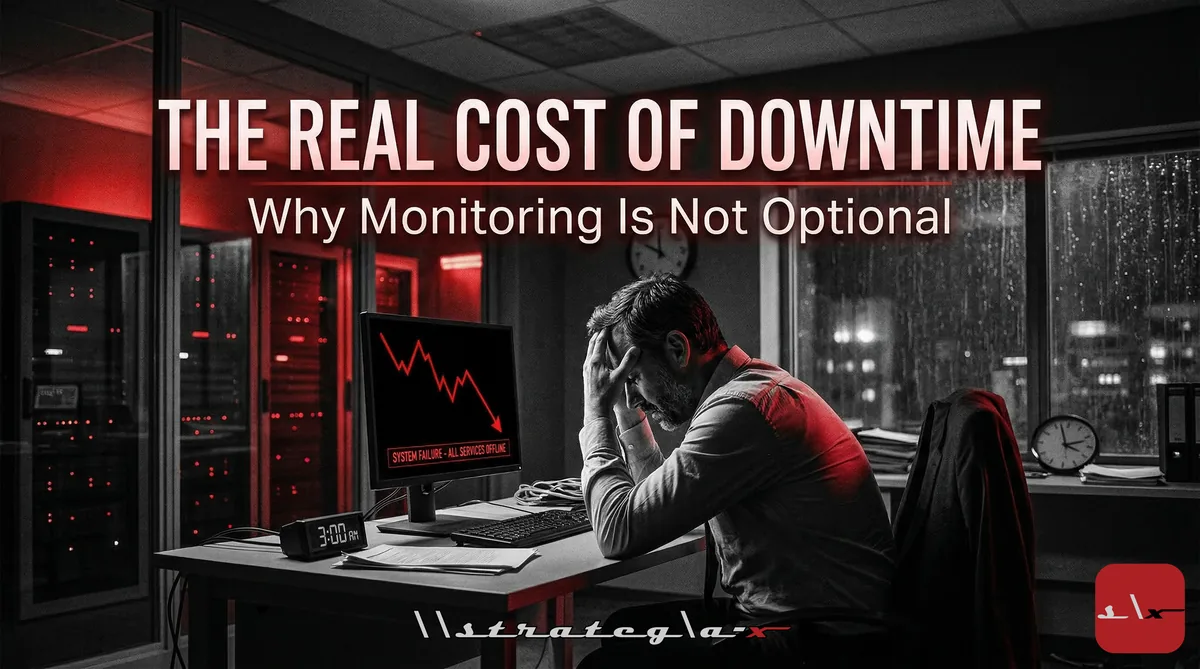
$5,600 Per Minute. That's the Average Cost of IT Downtime.
Let that number sit for a second.
Gartner published that figure and the industry collectively nodded, updated their disaster recovery slides, and then went right back to running production on hope and Slack alerts.
But here's the thing about that $5,600 number: it's an average. For enterprises running e-commerce platforms, financial services, or healthcare systems, the real number can be $10,000, $50,000, or $300,000+ per minute. And those are just the direct costs. The indirect damage, customer churn, brand erosion, regulatory penalties, employee burnout from fire drills, compounds for months after the incident resolves.
Downtime Isn't an IT Problem. It's a Business Continuity Problem.
The conversation around system monitoring has been stuck in the server room for too long. When your payment gateway goes down for 47 minutes on a Friday afternoon, the CFO doesn't care about the Kubernetes pod that crashed. They care about the $263,000 in abandoned carts, the 1,200 customers who got error pages, and the three enterprise clients who are now re-evaluating their contract renewal.
Downtime is a revenue event. A trust event. A competitive event. And the organizations that treat it as merely "something IT handles" are the ones writing postmortems that start with "We should have caught this sooner."
The Anatomy of a Preventable Outage
Let me walk you through a scenario I've seen play out dozens of times across organizations of every size:
- Week 1: A database query starts running 200ms slower than usual. Nobody notices because there's no baseline monitoring. It's within "acceptable" range, if anyone had defined what acceptable meant.
- Week 3: The slowdown has cascaded. API response times are up 40%. The frontend team notices their pages loading slower and opens a ticket. It gets triaged as P3.
- Week 5: Connection pool exhaustion during a traffic spike. The database can't handle the concurrent load because those slow queries are holding connections 3x longer than designed. The app throws 502 errors for 23 minutes during peak hours.
- The Postmortem: Root cause was a missing index on a table that grew from 100K to 14M rows over eight months. A single query. A single missing index. Twenty-three minutes of downtime. Eighty-seven support tickets. One very uncomfortable executive review.
Every stage of that timeline was preventable. Not with better engineers, with better observability.
Monitoring vs. Observability: There's a Difference
Most organizations have monitoring. They have dashboards. They have alerts. They might even have a PagerDuty rotation. But there's a critical gap between monitoring ("Is the server up?") and observability ("Why is the system behaving this way?").
- Monitoring tells you something is broken. Observability tells you why it's breaking, and ideally, before it breaks.
- Monitoring tracks predefined metrics. Observability lets you ask arbitrary questions about system behavior you didn't anticipate.
- Monitoring is reactive. Observability is investigative.
The three pillars of observability, metrics, logs, and traces, aren't just buzzwords. They're the difference between "we detected the outage in 45 seconds" and "a customer told us on Twitter 20 minutes later."
What Proactive Monitoring Actually Looks Like
The organizations that maintain 99.95%+ uptime don't do it by accident. They invest in systems that surface problems before they become incidents:
Infrastructure Layer
- Real-time CPU, memory, disk I/O, and network throughput tracking with anomaly detection, not just threshold alerts
- Capacity forecasting that projects when you'll hit resource limits weeks before it happens
- Automated health checks that validate not just "is the service running" but "is the service functioning correctly"
Application Layer
- Distributed tracing across microservices so you can follow a single request through your entire stack
- Error rate tracking with automatic alerting on deviation from baseline, not hardcoded thresholds that were set two years ago and never updated
- Performance profiling that identifies slow code paths before they cascade into user-facing latency
Business Layer
- Real-time transaction monitoring, not just "is the checkout page loading" but "are orders actually completing"
- Conversion funnel monitoring that alerts when drop-off rates spike, indicating a degraded experience even if no errors are thrown
- SLA compliance dashboards that give leadership real-time visibility into service quality
The Hidden Cost: Your Team
There's a cost of downtime that never makes it into the Gartner report: the human cost.
Engineers who are regularly pulled into fire drills burn out. On-call rotations that consistently result in 2 AM pages destroy work-life balance. Teams that spend more time fighting incidents than building features lose their best people to organizations that have their infrastructure under control.
I've watched entire platform teams turn over in 18 months because leadership treated monitoring as a "nice-to-have" instead of a core investment. The recruiting cost alone, $50-80K per senior engineer replacement, dwarfs what a proper observability stack would have cost to implement.
Start With These Five Steps
You don't need to boil the ocean. Start here:
- Define your SLOs. If you can't articulate what "healthy" looks like, you can't detect when something is degraded. Set Service Level Objectives for your critical paths and measure against them continuously.
- Instrument your critical path first. Don't try to monitor everything. Start with the user-facing flows that generate revenue: authentication, checkout, search, data processing. Get visibility where it matters most.
- Baseline everything. You can't detect anomalies without knowing what normal looks like. Collect 30 days of baseline data before setting alert thresholds. Let the data define the boundaries, not guesswork.
- Automate the first response. The fastest incident response is the one that doesn't require a human. Auto-scaling, circuit breakers, automated failover, self-healing pods, invest in systems that recover before anyone's pager goes off.
- Practice failure. Run chaos engineering experiments. Kill a service in staging. Simulate a database failover. Verify that your monitoring actually detects the problem and your runbooks actually resolve it. The worst time to discover your monitoring is broken is during a real outage.
The Bottom Line
Downtime isn't a technology problem. It's a preparedness problem. The tools exist. The patterns are well-documented. The ROI is unambiguous.
The organizations that invest in observability don't just avoid outages, they ship faster, retain better engineers, maintain customer trust, and make informed capacity decisions instead of reactive ones.
The question isn't whether you can afford to invest in monitoring. It's whether you can afford not to.
-Rocky
#Itops #Devops #Sre #Observability #Systemmonitoring #Uptime #Reliability #Cloudinfrastructure #Incidentresponse #Techleadership #EngineeringDreams #StrategiaX