"Why Does IT Cost So Much?"
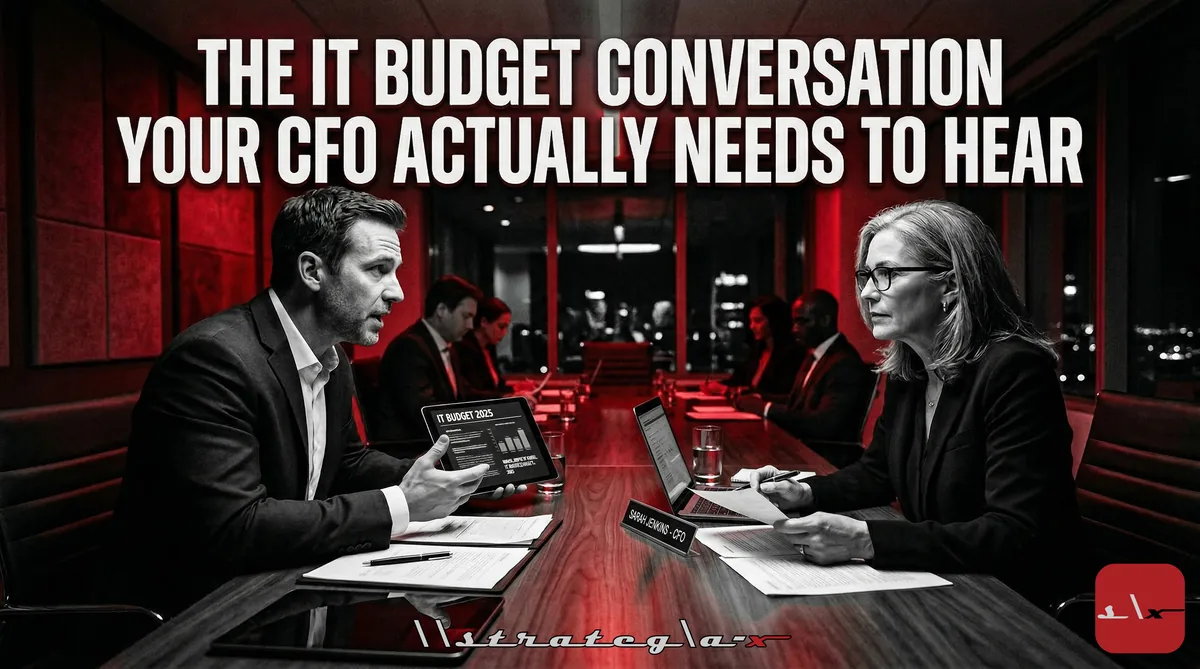
Every IT leader has heard this question. Usually from a CFO staring at a budget spreadsheet, trying to reconcile why the company spends hundreds of thousands, or millions, on infrastructure, licenses, headcount, and services that don't directly generate revenue.
And here's the uncomfortable truth: if your CFO sees IT as a cost center, it's probably because you've been presenting it like one.
Most IT budget conversations follow the same pattern: here's what we spent last year, here's what we need next year, here's the line items. Hardware. Software. Headcount. Support contracts. It reads like an expense report, because that's exactly what it is. And expense reports invite one response: where can we cut?
If you want a different answer, you need to ask a different question. Not "what does IT cost?" but "what does IT deliver?"
Why the Cost Center Framing Is Killing Your Budget
When IT is framed as a cost center, every budget conversation becomes a negotiation about minimizing expense. This creates a death spiral:
- Budgets get cut because IT can't demonstrate direct revenue impact
- Infrastructure degrades because maintenance gets deferred to meet reduced budgets
- Incidents increase because underinvested systems fail more frequently
- Emergency spending spikes because reactive fixes cost 3-10x more than proactive maintenance
- Leadership concludes IT is unreliable and further reduces strategic investment
- The cycle repeats, with IT perpetually underfunded and perpetually blamed for the consequences of underfunding
Sound familiar? This is the most common pattern I see in SMBs. It's not a technology problem. It's a communication problem.
Reframing IT as a Business Capability
The shift from cost center to business capability isn't about spin. It's about measuring and presenting the right metrics, the ones that connect IT spending to business outcomes.
1. Translate Technical Metrics Into Business Impact
Your CFO doesn't care about server uptime. They care about revenue. So translate:
- "We maintained 99.9% uptime" becomes "Our systems were available for every customer transaction, every hour we were open, resulting in zero revenue loss from system outages."
- "We blocked 14,000 phishing attempts" becomes "We prevented an estimated $2.98M in potential breach costs based on industry averages for companies our size."
- "We migrated to cloud infrastructure" becomes "We reduced infrastructure provisioning from 6 weeks to 2 hours, enabling the product team to launch three features that collectively drove $400K in new revenue."
Every IT metric has a business translation. Find it. Use it. Make it the centerpiece of your budget presentation.
2. Quantify the Cost of Inaction
The most powerful argument in any IT budget conversation isn't what you're asking for, it's what happens if you don't get it. Build a "cost of doing nothing" analysis:
- Deferred maintenance: What's the expected failure rate of aging infrastructure? What's the cost per hour of downtime? Multiply them.
- Security gaps: What's the average breach cost for a company your size? What's the probability of a breach given your current security posture? That's your risk exposure.
- Technical debt: How much longer do projects take because of legacy systems? What's the salary cost of those extra hours? That's the tax you're paying on every initiative.
- Employee productivity: How much time do employees waste on slow systems, manual processes, and workarounds? At their average hourly cost, what's the annual productivity drag?
CFOs understand risk quantification. They do it for insurance, for capital investments, for market exposure. Give them the same framework for IT and the conversation changes completely.
3. Build a Tiered Investment Model
Don't present a single budget number. Present three options:
- Tier 1, Maintenance Mode: Keep the lights on. Patch critical vulnerabilities. Replace hardware only when it fails. Accept known risks. This is the minimum spend to avoid catastrophic failure, and you should be explicit about what risks the organization is accepting at this level.
- Tier 2, Strategic Operations: Maintain current capabilities, address the top 3-5 risk areas, and fund one strategic initiative that directly supports a business goal. This is the "responsible stewardship" budget.
- Tier 3, Competitive Advantage: Everything in Tier 2, plus investments in capabilities that create measurable competitive differentiation, automation, AI integration, advanced analytics, customer experience improvements. This is the "IT as a growth engine" budget.
Let leadership choose their tier. Make sure each tier has clear outcomes and clear risks. This shifts the conversation from "approve or deny" to "which level of investment aligns with our business strategy."
4. Show ROI on Past Investments
Trust is built on track record. For every IT investment from the previous year, document the return:
- New CRM implementation → sales cycle reduced by 18%, pipeline visibility improved, $X in attributable revenue increase
- Network upgrade → zero unplanned outages (down from 4), estimated $Y in avoided downtime costs
- Security training program → phishing click rate dropped from 23% to 4%, zero successful breaches
When you can show that last year's investment delivered measurable results, this year's request gets a fundamentally different reception.
The Numbers That Actually Move CFOs
After years of these conversations, I've found that certain metrics consistently resonate with financial leadership:
- Revenue at risk: How much revenue depends on systems that IT maintains? For most businesses, the answer is "all of it."
- Cost avoidance: How much did IT investments prevent in potential losses? Breach prevention, downtime avoidance, compliance fines avoided.
- Productivity multiplier: For every $1 invested in IT tools and automation, how many labor hours were saved? At what cost per hour?
- Competitive parity: What are your competitors investing in IT? Falling behind isn't just a technology risk, it's a market position risk.
The Bottom Line
Your CFO isn't the enemy of IT investment. They're the gatekeeper of capital allocation, and they'll invest in anything that demonstrably drives business value. The problem isn't that IT budgets are inherently hard to justify. It's that IT leaders have been using the wrong language to justify them.
Stop presenting expenses. Start presenting outcomes, risks, and returns. When IT speaks the language of business, the budget conversation transforms from a fight into a strategy discussion.
Your CFO doesn't need to understand servers. They need to understand what those servers deliver. Show them that, and the budget follows.
-Rocky
#Itbudget #Cfo #Itstrategy #Roi #Businessoperations #Costoptimization #Digitaltransformation #Smb #Leadership #Techleadership #EngineeringDreams #StrategiaX