The Headcount Reflex
Something predictable happens in every growing SMB. Work piles up. Deadlines slip. The team is stretched. And the solution that everyone reaches for first is the same: "We need to hire someone."
Need someone to process invoices? Hire an AP clerk. Need someone to route leads to the right sales rep? Hire a sales coordinator. Need someone to send onboarding emails to new customers? Hire a customer success associate. Need someone to pull data from three systems and compile it into a weekly report? Hire an analyst.
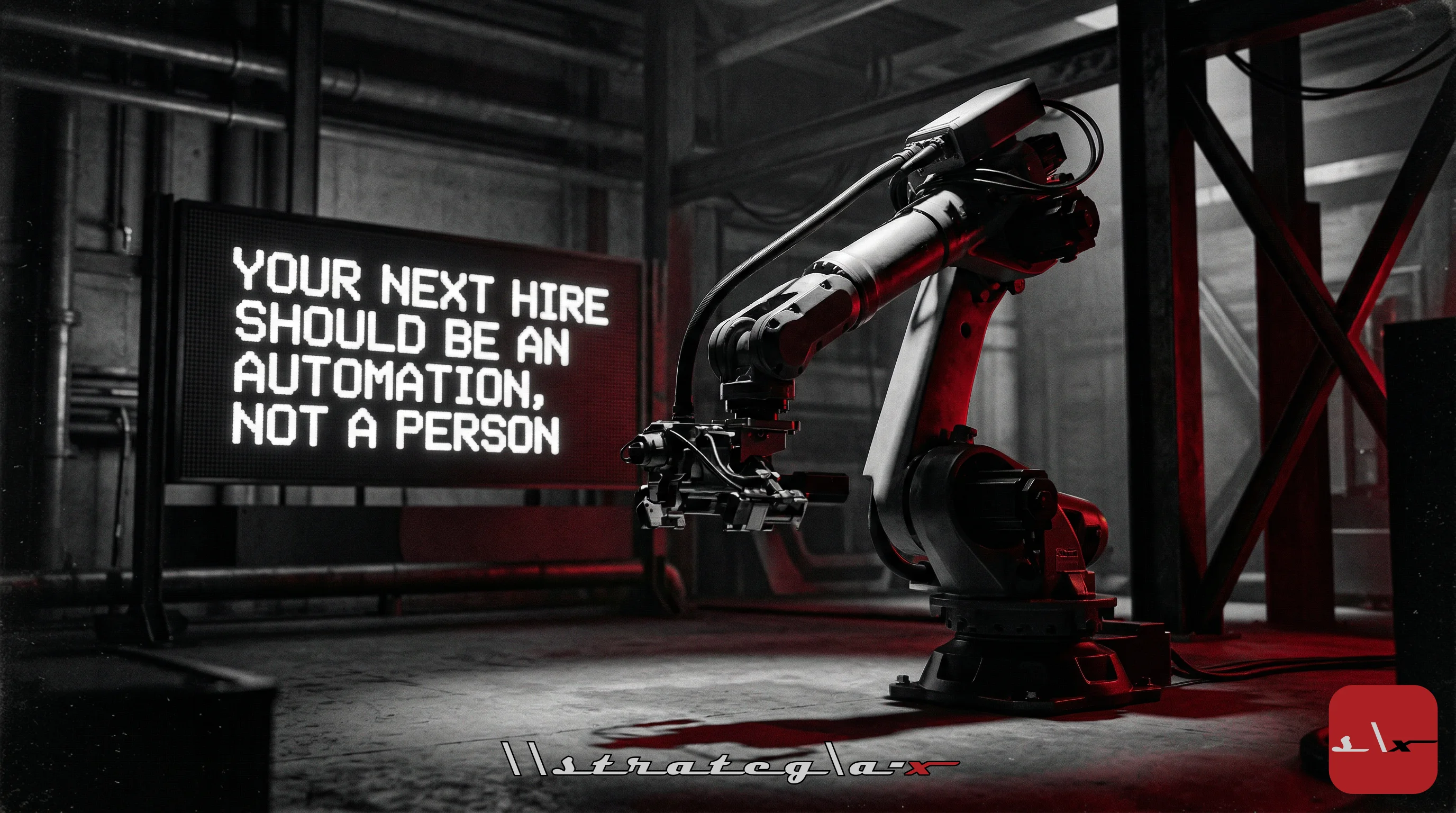
It's the headcount reflex, the default assumption that more work requires more people. And 10 years ago, it was usually the right call. But in 2026, for a significant percentage of these roles, the right answer isn't a person. It's an automation.
Not because people aren't valuable. But because paying a human $50,000-65,000 a year plus benefits to do work that a $200/month workflow automation can handle perfectly is not respecting that human's potential, or your budget.
The Math Is Brutal
Let's be direct about the economics. A full-time employee costs an SMB, on average, 1.25 to 1.4x their base salary when you factor in payroll taxes, benefits, equipment, software licenses, onboarding time, management overhead, and office space. A $55,000 hire actually costs $69,000-77,000 annually.
Compare that to automation:
- Zapier Business: $69-599/month depending on volume
- Make (formerly Integromat): $9-299/month
- Microsoft Power Automate: $15/user/month (often included in existing M365 licenses)
- Custom RPA bot: $5,000-15,000 one-time development + $100-500/month hosting
- AI assistants (ChatGPT API, Claude API): $20-500/month for most SMB use cases
Even at the high end, you're looking at $6,000-15,000 per year for an automation that works 24/7/365, never calls in sick, never needs a performance review, and executes the same process with perfect consistency every single time.
That's not 10% cheaper than a hire. It's 80-95% cheaper.
The Tasks You Should Automate Before Hiring
Not every role should be automated. Creative work, relationship building, strategic decision-making, complex problem-solving, these require humans. But there's a massive category of work that doesn't, and most SMBs are still throwing people at it. Here are the most common offenders:
1. Invoice Processing and Accounts Payable
Vendor sends invoice via email. Someone downloads it. Someone enters the line items into the accounting system. Someone matches it to the purchase order. Someone routes it for approval. Someone processes the payment.
Every single step of that workflow can be automated. AI-powered invoice processing tools like Stampli, BILL, or Tipalti can extract data from invoices (even PDFs and scanned images), match them to POs, route approvals based on rules you define, and process payments on schedule. The error rate drops. The processing time drops from days to minutes. And the AP clerk you were about to hire? They can focus on vendor relationship management and cash flow analysis instead.
2. Lead Routing and Follow-Up
A lead comes in through your website form. Someone checks it. Someone assigns it to a rep based on territory or product interest. Someone sends the initial acknowledgment email. Someone sets up the follow-up sequence. Someone logs it in the CRM.
All of this can be a zero-touch workflow. Form submission triggers CRM entry, lead scoring, automated assignment based on your rules, personalized acknowledgment email within 60 seconds, and a follow-up sequence that runs until the rep engages. Tools like HubSpot, ActiveCampaign, or even a Zapier-to-CRM workflow handle this effortlessly. The lead gets a response in under a minute instead of under a day, and no human touched it until the actual sales conversation.
3. Report Generation
Every Monday morning, someone spends two hours pulling data from the CRM, the ERP, the project management tool, and the finance system, combining it into a spreadsheet, formatting it into a presentation, and emailing it to leadership.
This is automation 101. Scheduled data pulls from APIs, automated aggregation, templated reports generated and delivered on a schedule. Tools like Power BI, Looker, or even Google Sheets with Apps Script can build and distribute these reports without human involvement. The "report monkey" role shouldn't exist in 2026.
4. Customer Onboarding Emails
New customer signs up. Someone sends a welcome email. Three days later, someone sends a getting-started guide. A week later, someone checks in. Two weeks later, someone sends a tips-and-tricks email. Each of these is manually triggered by someone checking a spreadsheet or setting calendar reminders.
This is what email automation was literally invented for. A drip sequence triggered by a CRM event, with conditional logic based on customer behavior. If they completed onboarding step 1, send step 2. If they haven't logged in after 5 days, send a nudge. Platforms like Customer.io, Intercom, or even Mailchimp handle this with zero ongoing human involvement after initial setup.
5. Data Entry and System Synchronization
Employee updates a record in System A. Then they manually update the same information in System B and System C. Or worse, they enter data into a spreadsheet that someone else later transcribes into the actual system.
Integration platforms (Zapier, Make, Workato, Power Automate) exist specifically to eliminate this. When data changes in one system, it automatically propagates to connected systems. No human in the loop. No transcription errors. No delays. If you're paying someone to be the bridge between two software systems, you're paying for a problem that was solved a decade ago.
Addressing the Fear Factor
Let's talk about the elephant in the room. Every time automation comes up, someone says: "So we're just replacing people with robots?"
No. And leaders who frame it that way are making a strategic mistake.
Automation doesn't replace people. It replaces tasks. Specifically, it replaces the repetitive, low-judgment, high-volume tasks that humans are overqualified to perform. The goal isn't to reduce headcount. The goal is to redirect human capability toward work that actually requires human capability.
Your AP clerk doesn't love data entry. They're good at vendor negotiation, cash flow management, and financial analysis, skills they never get to use because they're buried in invoice processing. Automate the processing, and you've upgraded their role without hiring anyone new.
Your sales coordinator doesn't love copy-pasting lead data between systems. They're good at building relationships, understanding customer needs, and supporting complex deals. Automate the data routing, and they become a strategic asset instead of an administrative one.
The companies that get automation right don't have fewer employees. They have the same employees doing dramatically higher-value work. Retention improves because people are doing interesting work instead of soul-crushing repetition. Output increases because human creativity is being applied to human-scale problems. And the business grows faster because you didn't spend six months recruiting, onboarding, and training someone to do a job that a workflow could handle in week one.
The Automation-First Hiring Framework
Before approving any new hire, run the role through this filter:
- Step 1: List every task this role would perform in a typical week.
- Step 2: For each task, ask: Does this require human judgment, creativity, or relationship skills? Or is it rule-based, repetitive, and data-driven?
- Step 3: If more than 60% of the tasks are automatable, don't hire. Build the automation first. Then reassess whether the remaining 40% justifies a full-time position, or whether those tasks can be distributed among existing team members whose automations just freed up 10-15 hours per week.
- Step 4: If you still need the hire after automation, you've now defined a higher-value role. The job description focuses on strategic work, not administrative overhead. You'll attract better candidates, and they'll stay longer because the role is actually interesting.
Where to Start
Don't try to automate everything at once. Pick the one process that consumes the most human hours for the least strategic value. Usually, it's one of the five I listed above. Build the automation. Measure the time savings. Then move to the next one.
Most SMBs can automate their first workflow in 1-2 weeks with off-the-shelf tools. No developers required. No six-month implementation project. Just a clear process, a modern automation platform, and the willingness to stop doing things the hard way because "that's how we've always done it."
The Bottom Line
Headcount is not a strategy. It's a cost. Every role you create should exist because a human is genuinely the best solution for the work, not because nobody considered the alternative.
Before you write that job description, before you post that listing, before you spend six months recruiting and onboarding, ask one question: Could an automation do this? If the answer is yes, build the automation. Invest the salary savings in tools, training, and higher-value roles. Your team will be smaller, sharper, and dramatically more productive. And your P&L will thank you.
-Rocky
#Automation #Rpa #Workflowautomation #Ai #Digitaltransformation #Smb #Processimprovement #Costoptimization #Hiring #Futureofwork #EngineeringDreams #StrategiaX