The Bus Factor
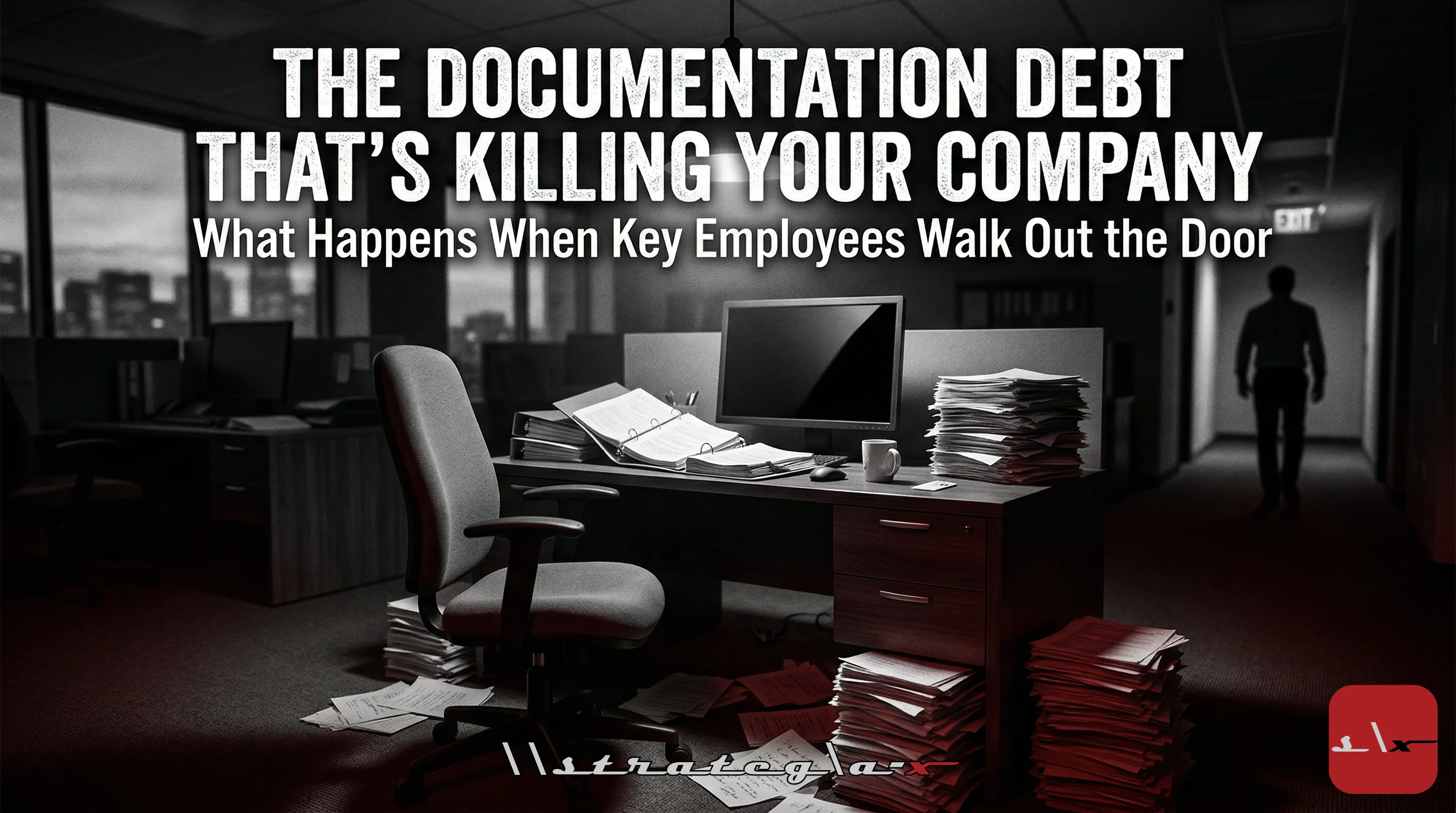
There's a concept in software engineering called the "bus factor", the number of people who would need to be hit by a bus before a project is in serious trouble. For most SMBs, the bus factor for critical business processes is one.
One person who understands the legacy ERP configuration. One person who knows how the quarterly financial reconciliation actually works. One person who maintains the integration between the warehouse system and the shipping platform. One person who remembers why the database was structured that way, what the custom fields mean, and where the backup scripts live.
These aren't edge cases. This is the norm. In a typical 50-person company, 5-8 individuals hold critical institutional knowledge that exists nowhere except inside their heads. When one of them leaves, retires, gets poached, burns out, or yes, gets hit by a bus, the knowledge leaves with them. And the company discovers, painfully, that they've been running on undocumented tribal knowledge held together by the memory of a few key individuals.
That's documentation debt. And it's compounding every day you ignore it.
What Documentation Debt Actually Costs
When a key employee departs and takes undocumented knowledge with them, the costs cascade across the organization:
Knowledge Recovery Time
The replacement doesn't just need to learn the job. They need to reverse-engineer the job. Without documentation, they're starting from zero, figuring out processes through trial and error, asking colleagues who have partial knowledge, and making mistakes that the departed employee would have avoided instinctively. Research from the Society for Human Resource Management estimates that replacing a mid-level employee costs 6-9 months of salary in lost productivity, recruitment, and training. When the role carries undocumented institutional knowledge, that timeline doubles.
Process Fragility
When the person who "just knows" how a process works leaves, the process doesn't break immediately. It degrades. Errors creep in. Steps get skipped. Workarounds that the previous person maintained invisibly stop being maintained. Quality drops. Timelines slip. And nobody can figure out why, because nobody understood the process well enough to know what's missing.
Decision Paralysis
"Why did we set it up this way?" becomes an unanswerable question. Was this configuration intentional or accidental? Is this field used by a downstream process? Can we change this without breaking something? Without documentation, every modification to an existing system becomes a gamble. Teams slow down. They avoid changes because they're afraid of unintended consequences. Innovation stalls because nobody is confident enough to touch the foundational systems.
Vendor Dependency
When you can't explain your own systems to yourself, you become dependent on vendors to explain them to you. Implementation partners who configured your ERP five years ago become the only people who understand how it works. And they charge accordingly, $200/hour to answer questions about a system you own but don't understand. Your documentation debt becomes their recurring revenue.
Why Documentation Never Gets Done
Everyone agrees documentation matters. Nobody does it. The reasons are predictable and universal:
"We're Too Busy Doing the Work to Write About the Work"
This is the most common excuse and the most dangerous. It treats documentation as separate from the work instead of as part of the work. The result is a team that runs faster and faster, accumulating more undocumented processes, creating a larger and larger knowledge gap that will eventually bring everything to a halt when the wrong person leaves.
"It Changes Too Fast to Document"
If your processes change too fast to document, they change too fast to train anyone on, too fast to audit, and too fast to optimize. The volatility isn't a reason to skip documentation. It's a reason to document more, using lightweight formats that are easy to update.
"Everyone Knows How It Works"
No, they don't. Everyone knows their piece of how it works. Nobody knows the whole thing. And the person who comes closest to knowing the whole thing is the single point of failure you can't afford to lose.
"We'll Document It When Things Calm Down"
Things never calm down. This is the equivalent of saying "we'll start exercising when we're less busy." If documentation isn't built into the workflow now, it won't happen at some mythical future date when everyone has spare time.
The Documentation Strategy That Actually Works
The goal isn't perfect documentation. It's sufficient documentation, enough that a competent person can understand and operate critical processes without the original creator being present. Here's how to build it:
1. Identify Your Critical Knowledge Holders
Map your bus factor. For every critical business process, identify who holds the knowledge. If the answer is one person, that process goes to the top of the documentation priority list. Focus on the highest-risk, most critical processes first, financial operations, customer-facing systems, core integrations, compliance workflows.
2. Use Runbooks, Not Novels
Nobody reads 40-page process documents. Write runbooks: step-by-step instructions that tell someone exactly what to do in exactly what order with exactly what tools. Include screenshots. Include the specific commands. Include the login locations. Include what "success" looks like at each step. Write for the person who has never done this before and needs to do it correctly on their first attempt.
3. Record, Don't Write
For complex processes, a 10-minute screen recording with narration is worth more than 10 pages of written documentation. Tools like Loom, Scribe, or Tango can automatically generate step-by-step documentation from screen recordings. The knowledge holder spends 15 minutes recording themselves doing the thing. The documentation exists immediately. The barrier to creation drops by an order of magnitude.
4. Document at the Moment of Action
Don't schedule documentation as a separate task. Build it into the workflow. When you set up a new integration, document the configuration before you move to the next task. When you resolve a complex issue, write the runbook while the solution is still fresh. When you build a workaround, document why the workaround exists and what would need to change to eliminate it. The best time to document something is immediately after doing it. The worst time is six months later from memory.
5. Establish a Living Knowledge Base
Choose a central platform, Notion, Confluence, SharePoint, or even a well-organized Google Drive. Establish a clear structure: one section per department, one page per process, one runbook per task. Assign ownership: someone reviews and updates each critical document quarterly. Stale documentation is almost as dangerous as no documentation, because it creates false confidence. Keep it current or mark it as outdated.
6. Make It a Hiring and Offboarding Requirement
Every new hire should be able to onboard using existing documentation. If they can't, the documentation is insufficient, and their first task should be to improve it. Every departing employee should have a documentation sprint as part of their notice period: dedicated time to document every process, workaround, and piece of institutional knowledge they carry. Two weeks of documentation from a departing employee is worth more than two months of the replacement trying to figure it out alone.
The Bottom Line
Every undocumented process is a ticking time bomb. You don't know when the person holding the knowledge will leave. You only know that they will, eventually. And when they do, the cost of the missing documentation will be measured in months of lost productivity, six-figure recovery projects, and the slow degradation of systems that nobody fully understands anymore.
Documentation isn't overhead. It's insurance. It's the difference between a smooth transition and a crisis. Between operational resilience and operational fragility. Between a company that can scale and a company that's one resignation away from chaos. Start with your highest-risk knowledge holders. Build the runbooks. Record the processes. Make it a discipline, not a project. The documentation you write today is the disaster you prevent tomorrow.
-Rocky
#Documentationdebt #Knowledgemanagement #Businesscontinuity #Operationalresilience #Smb #Digitaltransformation #Processdocumentation #Institutionalknowledge #Onboarding #EngineeringDreams #StrategiaX