The Law Nobody Taught You in Business School
In 1967, computer scientist Melvin Conway made an observation so consistently true that it became a law: "Any organization that designs a system will produce a design whose structure is a copy of the organization's communication structure."
Translation: your technology architecture is a mirror of your org chart. If your departments don't talk to each other, your systems won't either. If your teams are territorial, your data will be locked in silos. If your leadership is fragmented, your technology stack will be fragmented.
Conway's Law isn't a suggestion. It's a force of nature. And it explains why most technology problems aren't actually technology problems at all, they're organizational problems wearing a technology disguise.
How Your Org Chart Shows Up in Your Tech Stack
Walk through any mid-sized company's technology environment, and you'll find Conway's Law operating at every level:
The CRM That Marketing Can't Access
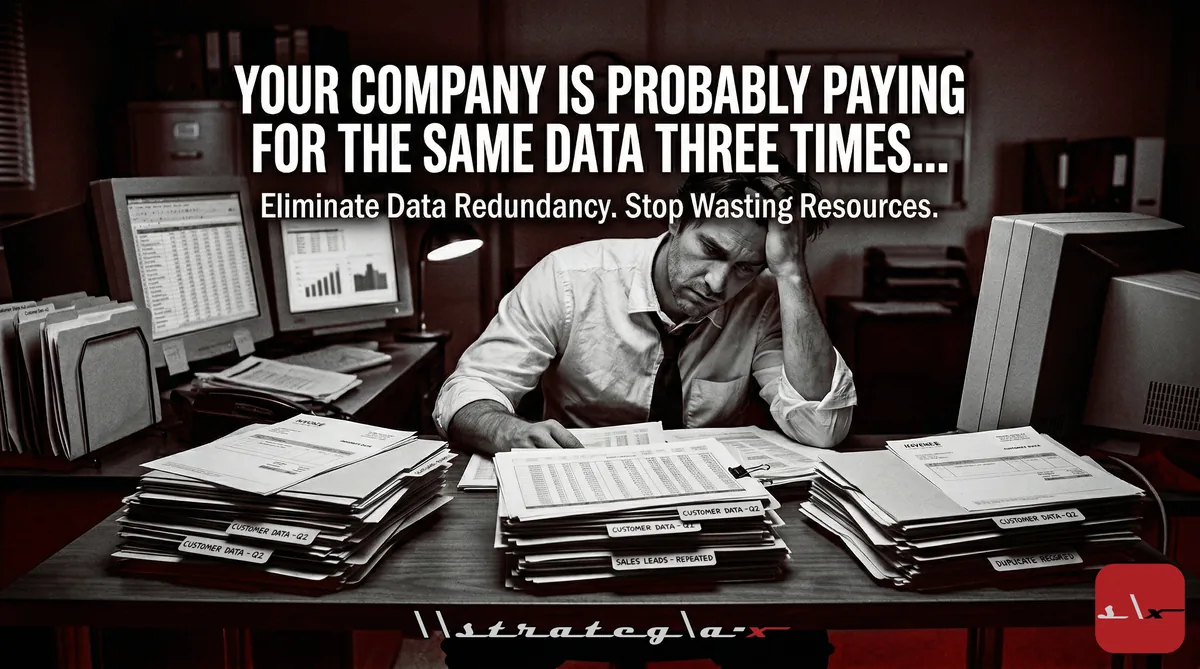
Sales owns the CRM. They configured it for their pipeline. Marketing needs customer data for campaigns, but they can't access the CRM directly, they get a CSV export once a month from a sales ops person who's too busy to prioritize it. So marketing bought their own platform with its own contact database. Now the same customer exists in two systems with different data, and nobody has the complete picture. This isn't a technology problem. It's a turf problem. Sales and marketing don't share because the organization doesn't incentivize them to share. The technology simply reflects that reality.
The ERP That Finance Guards Like Fort Knox
Finance controls the ERP. They configured access permissions so tightly that operations can't pull their own reports. So operations built a parallel reporting system in spreadsheets, pulling data manually from the ERP once a week and maintaining their own version of truth. Now leadership gets two different numbers for the same metric and spends meetings arguing about which one is right. This isn't an ERP limitation. It's a trust problem. Finance doesn't trust other departments with direct data access. The restrictive technology configuration is just the trust deficit made visible.
Three Project Management Tools for One Company
Engineering uses Jira. Marketing uses Asana. Operations uses Monday.com. Each department chose the tool that fit their workflow. None of them integrate. Cross-department projects require manual status updates across three platforms. Nobody has visibility into the full picture. This isn't a tool selection problem. It's an autonomy problem. Each department was allowed to make independent technology decisions because the organization doesn't have centralized technology governance. The three tools aren't the disease, they're the symptom.
The Data Lake That Nobody Drinks From
The company invested $200,000 in a data warehouse that was supposed to unify all reporting. Two years later, three departments still run their own reports from their own systems because they don't trust the central data, or because their specific metrics weren't included in the warehouse design. The data lake exists. Nobody uses it. This isn't a data engineering failure. It's a stakeholder alignment failure. The warehouse was built by IT without deep involvement from the business teams who were supposed to use it. The technology works perfectly. The organizational buy-in never happened.
Why You Can't Fix the Tech Without Fixing the Org
Here's where most companies go wrong: they see the technology dysfunction and try to solve it with more technology. Let's implement an integration platform! Let's do a data migration! Let's standardize on one tool!
And it fails. Every time. Because the organizational dynamics that created the dysfunction are still operating. You can force everyone onto the same CRM, but if sales and marketing still don't collaborate, the data will still be siloed, just within the same system instead of across two. You can build a unified data warehouse, but if departments don't trust each other's data, they'll still maintain shadow spreadsheets.
Technology integration without organizational integration is expensive cosmetic surgery. It changes the appearance without changing the underlying condition. The dysfunction finds a new way to express itself, usually within 6 months of go-live.
The Diagnostic: Reading Your Tech Stack Like an Org Chart
Your technology environment is a diagnostic tool. Use it. Walk through your systems and ask these questions:
- Where are the data silos? Every data silo maps to an organizational boundary. The departments that don't share data are the departments that don't share goals, incentives, or trust.
- Where are there duplicate tools? Duplicate tools map to autonomous fiefdoms. Each tool represents a department that made an independent decision because no one with cross-functional authority said "we already have a tool for that."
- Where are the manual handoffs? Every manual data transfer between systems is a process boundary between teams. The more painful the handoff, the worse the cross-team relationship.
- Where are people hoarding data? Data hoarding maps to political protection. When someone insists on controlling access to information, they're protecting their relevance, their budget, or their power, not the data.
- Where are there workarounds? Every spreadsheet workaround is a signal that the official system doesn't serve that team's actual needs, usually because they weren't consulted when the system was designed.
This diagnostic will tell you more about your organizational health than any employee survey.
Fixing the Organization to Fix the Technology
The path forward isn't "better technology." It's better organizational design that technology can then reflect:
1. Align Incentives Across Departments
If sales is incentivized only on closed deals and marketing only on leads generated, they'll never share data willingly, because they're not measured on shared outcomes. Create cross-functional KPIs. Measure marketing on pipeline contribution. Measure sales on lead utilization. When teams share goals, they share data. When they share data, the technology integration follows naturally.
2. Establish Cross-Functional Technology Governance
No department should purchase or implement technology in isolation. Create a lightweight governance process, not a bureaucratic committee, but a shared evaluation framework. Does this tool integrate with our existing stack? Does it overlap with something we already have? Who else needs access to this data? Technology decisions made in isolation produce isolation in technology.
3. Break Down Information Fiefdoms
Data access should default to open, with exceptions for genuinely sensitive information. If a team is restricting access to operational data, challenge the restriction. The question isn't "why does this team need access?" It's "why don't they have access?" Every locked-down report and restricted dashboard should require justification. Most won't survive scrutiny.
4. Design Technology Around Workflows, Not Departments
Stop organizing systems by department. Organize them by business process. The order-to-cash process spans sales, operations, finance, and customer success. Design the technology to support that end-to-end flow, not four departmental views of it. When the technology follows the workflow instead of the org chart, cross-functional collaboration becomes the default instead of the exception.
5. Invest in Integration as Organizational Infrastructure
Your integration platform (Zapier, Make, Workato, Power Automate) isn't a nice-to-have. It's the connective tissue that forces data to flow across organizational boundaries even when people resist. Automated data flows between systems are harder to hoard, harder to gate-keep, and harder to ignore. Integration doesn't just connect tools. It connects teams.
The Bottom Line
Your technology stack is not broken because you picked the wrong tools. It's broken because it's faithfully reflecting the communication patterns, power dynamics, and trust levels of your organization.
Conway's Law is undefeated. You cannot build integrated technology on top of a fragmented organization. Fix the org chart first, align incentives, break down fiefdoms, design around workflows instead of departments, and the technology will follow. Try to fix the technology without fixing the organization, and you'll spend a fortune building a beautiful system that nobody uses. The invisible org chart always wins. Make sure yours is worth mirroring.
-Rocky
#Conwayslaw #Organizationaldesign #Technologystrategy #Datasilos #Businessoperations #Systemintegration #Smb #Digitaltransformation #Leadership #EngineeringDreams #StrategiaX