
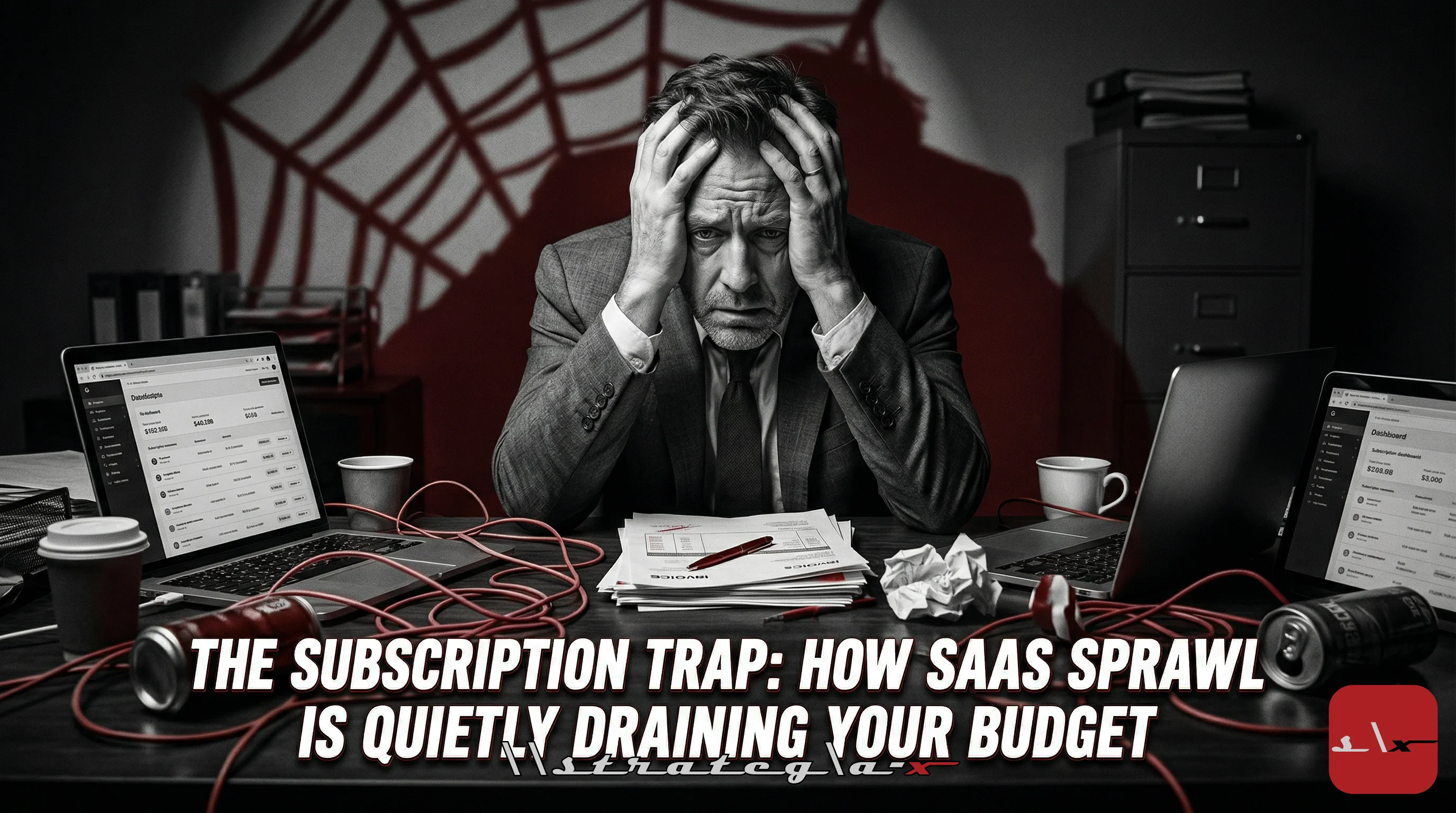
Death by a Thousand Subscriptions
Open your company's credit card statement right now. Scroll through the recurring charges. Count the software subscriptions. If you're like most SMBs, you'll find somewhere between 40 and 130 SaaS subscriptions actively billing your company every month.
Now ask yourself: how many of those are your team actually using?
Research from Zylo's SaaS Management Index reveals that the average company wastes 25% of its SaaS spend on unused or underutilized licenses. For a company spending $15,000/month on SaaS, a modest figure for a 50-person firm, that's $45,000 per year in software nobody is using. Just sitting there. Billing. Every month. While nobody notices.
Welcome to SaaS sprawl, the slow, silent budget drain that has become one of the most overlooked cost centers in modern business.
How SaaS Sprawl Happens
Nobody wakes up and decides to subscribe to 100 software tools. It happens gradually, through completely rational individual decisions that create an irrational collective result:
The Departmental Purchase
Marketing needs a social media scheduler. Sales needs a prospecting tool. HR needs an applicant tracking system. Each department evaluates and purchases their own solution independently. Nobody checks whether an existing tool already covers that functionality. Nobody asks whether the company-wide platform could be configured to do the same thing. Each purchase makes sense in isolation. In aggregate, you end up with 5 tools that do overlapping things, none of which talk to each other.
The Free Trial That Never Ended
Someone signs up for a 14-day free trial. It auto-converts to a paid subscription. The person who signed up either forgot about it, left the company, or is still using it for one minor task that doesn't justify the cost. But nobody cancels it because nobody knows it exists. These zombie subscriptions accumulate silently. Most companies discover dozens of them during their first SaaS audit.
The "Just In Case" License
You bought 50 Salesforce licenses because you had 45 employees and wanted room to grow. You now have 38 employees using it. Those 12 unused licenses cost $1,800/month. But nobody adjusted the seat count because "we might hire soon" or "it's easier to keep them." Multiply this across every per-seat SaaS tool in your stack, and you're paying for a ghost workforce that exists only in your subscription management console.
The Tool That Outlived Its Purpose
You subscribed to a project management tool for a specific initiative. The initiative ended. The tool didn't. You migrated to a new platform but never cancelled the old one because "some people still have data in there." That was 18 months ago. The data hasn't been accessed since. The subscription is still active.
The Hidden Costs Beyond the Subscription Fee
The monthly subscription is only the visible cost. SaaS sprawl creates cascading costs that don't appear on any invoice:
Integration Overhead
Every tool that doesn't integrate with your core systems creates a data silo. Someone has to manually export from Tool A and import into Tool B. Or worse, the data simply lives in two places with two different versions of truth. The labor cost of managing integrations (or compensating for the lack of them) between a sprawling SaaS stack often exceeds the subscription costs themselves.
Training and Context Switching
Every new tool requires training time. Every tool switch during the workday is a context switch. When your team operates across 12+ applications daily, the cognitive overhead of remembering different interfaces, different login credentials, and different workflows is a measurable productivity tax. Research shows that application switching costs employees an average of 9% of their productive time, nearly an hour per day.
Security and Compliance Risk
Every SaaS application that touches company data is an attack surface. Every tool with stored credentials is a potential breach point. Every shadow subscription that IT doesn't know about is a compliance gap that auditors will find, usually at the worst possible time. The more tools in your stack, the larger your exposure. Each unmanaged SaaS application is a door you didn't know was open.
Vendor Management Burden
Renewals. License negotiations. Contract terms. Security questionnaires. SOC 2 compliance verification. Each vendor relationship requires management overhead. At 50+ vendors, that's a meaningful operational burden that doesn't show up in anyone's job description but consumes real hours every month.
The SaaS Rationalization Playbook
Cleaning up SaaS sprawl isn't a one-time project, it's an ongoing discipline. But the first cleanup usually delivers dramatic results. Here's how to do it:
1. Build Your SaaS Inventory
Before you can rationalize, you need visibility. Pull 12 months of credit card and accounts payable records. Use a SaaS management platform (Zylo, Productiv, Torii, or even a well-structured spreadsheet) to catalog every subscription. Include: tool name, owner, monthly cost, number of licenses, number of active users, and business function. Most companies discover 30-40% more subscriptions than they thought they had during this exercise.
2. Measure Actual Usage
Licenses purchased doesn't equal licenses used. Check login data. Review feature utilization. Talk to the teams, ask them which tools they actually use daily, which they use occasionally, and which they've forgotten about. Categorize every subscription as: essential, underutilized, or unnecessary. Be ruthless. If fewer than 50% of licensed users actively use the tool, it's underutilized.
3. Eliminate Redundancy
Map every tool to a business function. If multiple tools serve the same function, pick the best one and consolidate. You don't need three project management tools, two file sharing platforms, and four communication apps. Identify the overlaps. Choose the winner. Migrate. Cancel the rest. This step alone typically eliminates 15-25% of total SaaS spend.
4. Right-Size Your Licenses
For every remaining tool, match the license count to actual usage. If 35 people use a tool licensed for 50, reduce to 40 (keeping a small buffer). If you're on an enterprise plan but only use features available on the professional tier, downgrade. Contact vendors and renegotiate. Most will accommodate, they'd rather keep a right-sized customer than lose one who realizes they've been overpaying.
5. Implement Procurement Governance
This is the discipline that prevents sprawl from returning. Every new SaaS purchase, regardless of cost, goes through a simple evaluation: Does an existing tool already do this? Does it integrate with our core stack? Who owns it? What's the exit strategy? Require approval for any new subscription over $50/month. Not to slow innovation, to prevent the uncontrolled accumulation that created the problem in the first place.
6. Schedule Quarterly Reviews
Review your SaaS inventory quarterly. Check utilization. Identify new zombie subscriptions. Verify that license counts still match headcount. A quarterly cadence catches sprawl before it compounds, and it keeps the SaaS stack lean as your business evolves.
The Bottom Line
SaaS sprawl isn't dramatic. It's not a crisis that shows up on a Monday morning. It's a slow leak, $500 here, $200 there, an unused license block that nobody questions. But those leaks compound into a flood that typically represents 20-30% of a company's total software spend, money that's producing zero value.
Every dollar you spend on software nobody uses is a dollar you can't spend on software that matters, people who deliver, or growth that compounds. Audit your stack. Kill the zombies. Right-size the survivors. And build the governance to keep it clean. Your SaaS budget should fund your competitive advantage, not your vendor's quarterly earnings call.
-Rocky
#Saas #Softwaremanagement #Costoptimization #Itspend #Technologytrends #Smb #Licensemanagement #Cloudspend #Procurement #EngineeringDreams #StrategiaX