
The Meeting That Started It All
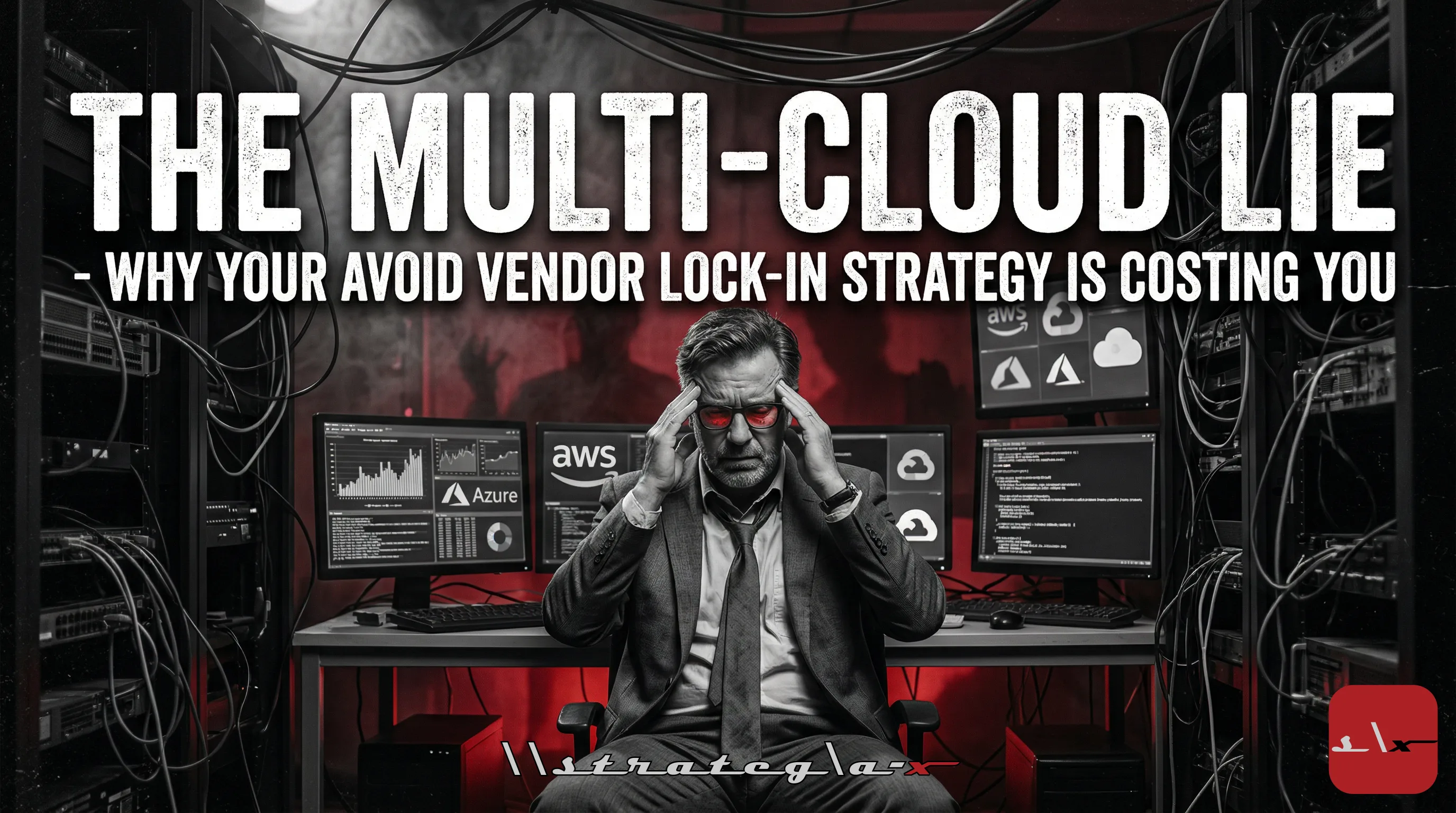
I sat in a strategy meeting last quarter where a CTO proudly announced they were "going multi-cloud to avoid vendor lock-in." The board nodded approvingly. The CFO smiled. Nobody asked the follow-up question that should have been asked: at what cost? Six months later, that same company is running three cloud environments, none of them well, with a DevOps team stretched so thin they can't ship features because they're too busy maintaining three different sets of infrastructure tooling. Their "avoid lock-in" strategy didn't avoid anything, it just tripled the bill and halved the output.
This is the multi-cloud lie, and it's one of the most expensive delusions in enterprise IT. Companies adopt multi-cloud strategies out of fear, fear of being trapped by a single vendor, and end up trapped by something far worse: operational complexity that eats budgets, burns out teams, and produces architecture so generic it leverages none of the platforms well. The fear of lock-in is rational. But the cure, for the vast majority of businesses, is worse than the disease.
The Numbers Nobody Wants to Talk About
Let's start with what the research actually says, because multi-cloud advocates love to cite adoption numbers while conveniently ignoring cost numbers. According to Flexera's 2025 State of the Cloud Report, 84% of organizations say managing cloud spend is their top cloud challenge. Not security. Not performance. Not innovation. Cost. And organizations are exceeding their cloud budgets by an average of 17%.
Now layer multi-cloud on top of that. The same report shows that 27% of cloud spend is wasted, and that number has ticked upward as multi-cloud and AI complexity compounds. At the scale Gartner projects for 2025 cloud spending, $723 billion, we're talking about roughly $200 billion in wasted cloud spend globally. Multi-cloud environments are disproportionately represented in that waste because they add governance complexity, duplicated services, and cross-cloud data transfer costs that single-cloud shops simply don't face.
According to Harness's "FinOps in Focus" report, $44.5 billion in infrastructure cloud waste is projected for 2025 alone, driven by the disconnect between FinOps teams and the developers actually provisioning resources across multiple platforms.
The Hidden Tax of Multi-Cloud Complexity
The direct cloud bill is only the beginning. The real cost of multi-cloud hides in places most CFOs never look:
- Duplicated tooling. Every cloud provider has its own identity management, monitoring, logging, networking, and deployment tooling. Running two clouds doesn't double your tooling cost, it more than doubles it, because you also need abstraction layers to bridge them. Terraform, Pulumi, Crossplane, these tools exist specifically because multi-cloud is so painful that an entire industry has formed around making it bearable.
- Split expertise. Your team can be great at AWS or great at Azure. They almost certainly cannot be great at both. The HashiCorp 2024 State of Cloud Strategy Survey found that only 8% of organizations qualify as "highly cloud mature", and cloud maturity requires deep expertise. Splitting your team across multiple platforms guarantees shallow expertise across all of them.
- Lowest-common-denominator architecture. When you design for multi-cloud portability, you can't use any provider's best features. No DynamoDB. No Azure Cosmos DB. No BigQuery. You end up running generic Postgres on generic VMs behind generic load balancers, paying premium cloud prices for commodity architecture you could run cheaper on bare metal.
- Data gravity and egress costs. Data doesn't move between clouds for free. Egress charges are one of the most predatory pricing mechanisms in cloud computing, and multi-cloud strategies guarantee you'll pay them constantly as data moves between environments.
The Lock-In Fear Is Overblown
Let's address the fear directly. Yes, vendor lock-in is real. If you build everything on AWS Lambda with DynamoDB and SQS, migrating to Azure is a significant engineering project. But here's the question nobody asks: how likely is that migration, and how much are you paying right now to insure against it?
Most companies that cite "avoiding lock-in" as a multi-cloud justification have never actually needed to migrate between clouds. They're paying a permanent complexity tax to hedge against a scenario that, for 90% of SMBs, will never happen. It's like buying earthquake insurance in Kansas, technically possible, astronomically unlikely, and the premium is destroying your monthly budget.
Here's what actual lock-in looks like in practice: your biggest risk isn't your cloud provider, it's your data model, your business logic, and your team's institutional knowledge. Those are locked in regardless of which cloud you use. Switching from AWS to Azure doesn't help you if your entire application architecture needs to be rewritten anyway.
The Multi-Cloud Staffing Problem Nobody Can Solve
This is where the multi-cloud fantasy completely falls apart for small and mid-sized businesses. The top-performing cloud organizations rely on centralized platform teams to standardize operations, 67% of highly mature organizations use them. But building a platform team requires exactly the kind of deep, specialized talent that is brutally expensive and painfully scarce.
Now multiply that problem by the number of clouds you're running. Each additional cloud provider requires:
- Engineers who understand that provider's networking model
- Security specialists who know that provider's IAM, encryption, and compliance tooling
- DevOps engineers who can maintain CI/CD pipelines for that provider's deployment targets
- FinOps analysts who can interpret that provider's billing and optimize pricing models
You don't need one cloud team. You need N cloud teams, where N is the number of providers you're running. For an enterprise with a $50M IT budget, that's expensive but feasible. For an SMB spending $200K a year on cloud, it's absurd. You're spending more on the people to manage the multi-cloud strategy than you're spending on the cloud itself.
What Smart Companies Actually Do
The companies I've seen get cloud strategy right don't chase multi-cloud for ideology. They make deliberate, pragmatic decisions:
- Go deep on one primary cloud. Pick the provider that best fits your workload profile and go all-in on their native services. Use their managed databases, their serverless compute, their AI/ML platforms. You'll get better performance, lower operational overhead, and volume discounts that multi-cloud strategies forfeit.
- Architect for portability at the application layer, not the infrastructure layer. Containerize your workloads. Use open standards for data formats. Keep your business logic decoupled from provider-specific SDKs where it matters. This gives you a realistic escape hatch without paying the daily multi-cloud tax.
- Use secondary clouds strategically, not ideologically. There are legitimate reasons to use a second cloud: a specific SaaS product that only runs on Azure, a data sovereignty requirement in a specific region, or a genuinely superior service like BigQuery for analytics. That's not multi-cloud strategy, that's pragmatic procurement. The difference matters.
- Invest in your team's depth, not breadth. A team of five engineers who are deeply expert in one cloud will outperform a team of fifteen generalists spread across three. Depth compounds. Breadth dilutes.
The Bottom Line
Multi-cloud is a tax that most companies pay voluntarily because they're afraid of a lock-in scenario that will almost certainly never materialize. Meanwhile, the real costs, duplicated tooling, split expertise, lowest-common-denominator architecture, inflated staffing requirements, and cloud waste hovering near 30%, are materializing every single month.
For 90% of SMBs, multi-cloud is not a strategy, it's a cope. It's the organizational equivalent of keeping one foot on the dock and one foot on the boat: you feel safer, but you're actually in the most dangerous position possible. Pick a cloud. Go deep. Build real expertise. Use your provider's best tools instead of their lowest-common-denominator equivalents. The companies that master one platform will outbuild, outship, and outcompete the companies still trying to be mediocre at three.
-Rocky
#Multicloud #Cloudstrategy #Technologytrends #Vendorlockin #Cloudcomputing #Smb #Infrastructure #EngineeringDreams #StrategiaX