The Cheapest Bid Is the Most Expensive Choice
You know what's fun? Watching a company spend six months "optimizing" their vendor selection process, run a competitive bid, pick the cheapest option on the spreadsheet, and then spend the next three years bleeding money trying to make that decision work. I've seen it happen more times than I can count. A $200,000 contract turns into a $2 million problem, not because the vendor was fraudulent, but because nobody bothered to calculate what that vendor decision would actually cost beyond the invoice price.
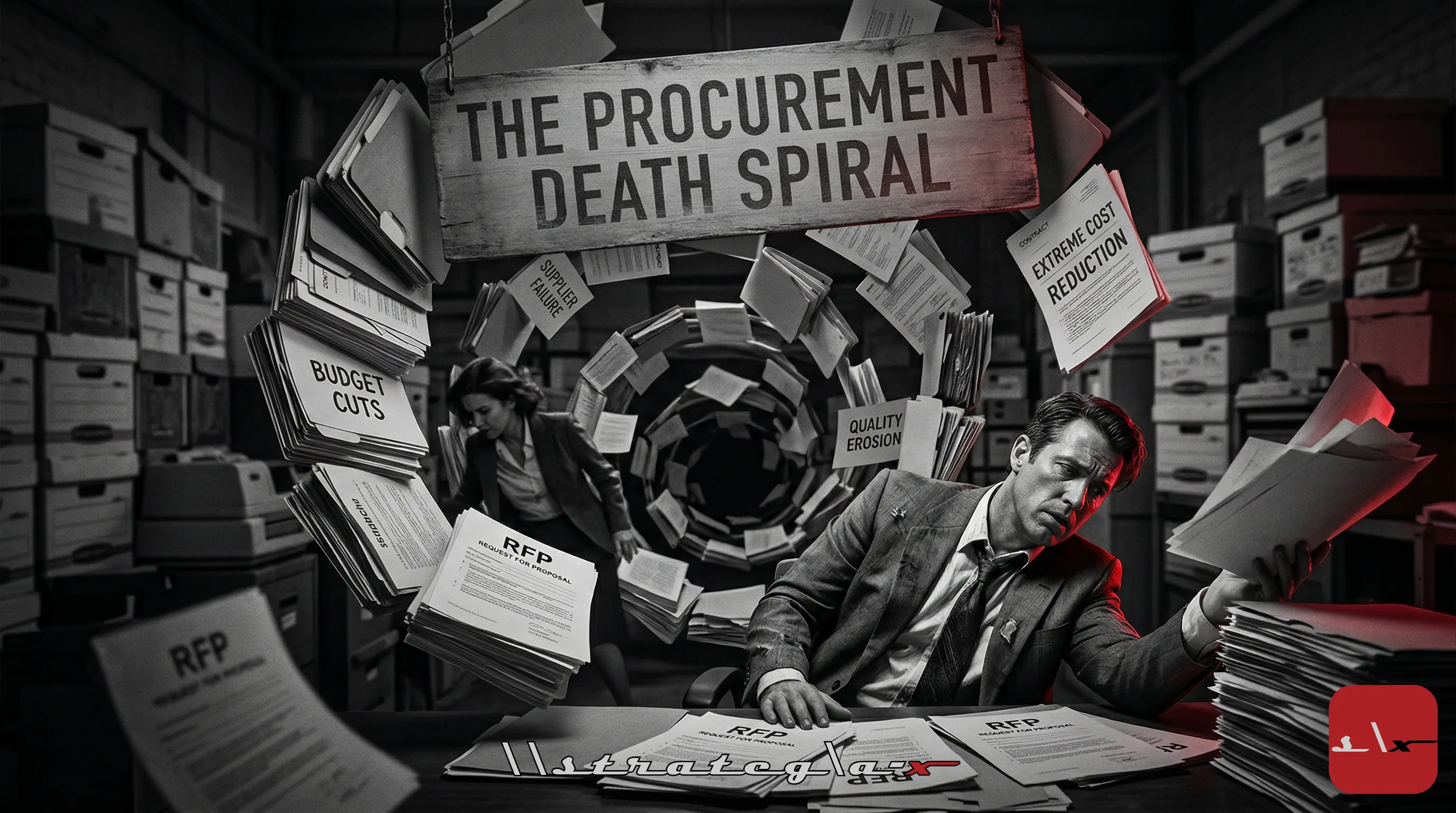
The procurement world has a dirty little secret: the cheapest vendor is almost always the most expensive choice. And once you're locked in, the costs don't add up linearly. They compound. Every workaround, every quality failure, every missed SLA creates downstream consequences that create their own costs. Welcome to the Procurement Death Spiral.
The Illusion of Savings
Here's how it starts. You need a vendor for a critical service or component. You send out an RFP, get five proposals back, and some well-meaning person in finance circles the lowest number. "Look at the savings!" they say. Everybody high-fives. The PO gets signed.
What nobody calculated was the total cost of ownership. According to Gartner's research on sourcing and procurement, 72% of sourcing and procurement leaders now say they plan to deliver value by optimizing total cost of ownership, not just purchase price. That means 28% are still chasing the lowest number on the bid sheet. And even among the 72% who say they're focused on TCO, implementation remains resource-intensive with limited adoption.
The purchase price is the tip of the iceberg. Below the waterline sits onboarding costs, integration time, training, quality assurance overhead, support escalation frequency, rework rates, contractual penalties you'll never enforce, and the opportunity cost of your best people spending their time managing a bad vendor instead of doing productive work. When you only evaluate the invoice price, you're making a decision based on roughly 30-40% of the actual cost.
The Compounding Mechanism
A bad vendor decision doesn't sit still. It compounds. Here's the sequence I've watched play out across dozens of organizations:
- Month 1-3: Minor quality issues surface. Your team flags them. Vendor promises to fix them. You give them the benefit of the doubt.
- Month 4-6: Quality issues persist. Your team starts building workarounds. Internal processes bend to accommodate the vendor's limitations. Nobody tracks the time spent on this.
- Month 7-12: Workarounds are now baked into your operations. New employees are trained on the workarounds as if they're standard procedure. The vendor's support team has turnover, and you're re-explaining your setup to new reps every other month.
- Year 2: Someone finally calculates what this vendor is actually costing. The number is staggering. But switching now means migrating data, retraining staff, eating contractual exit fees, and running parallel systems during transition. So you stay.
- Year 3: You're now spending more on managing the vendor relationship than the contract is worth. But you've renewed because "it's too disruptive to switch."
McKinsey's research on contracting for performance found that poor supplier performance can result in total costs 10 to 20 percent higher than the contracted category price. In one industrial manufacturing case they studied, rework caused by supplier quality failures added costs equal to 30 to 50 percent of revenues in affected commodity segments. That's not a rounding error. That's a business-altering number.
The Hidden Cost Multipliers Nobody Tracks
Most organizations don't have a line item in their P&L for "cost of managing bad vendors." But the costs are real and they show up everywhere:
- Internal labor absorption: Your engineers, project managers, and operations staff spend hours per week compensating for vendor shortcomings. According to Gartner, employees spend up to 27% of their time dealing with data and quality issues, a significant portion of which stems from vendor-supplied inputs.
- Opportunity cost: Every hour your team spends firefighting a vendor problem is an hour they're not spending on growth initiatives, process improvements, or innovation.
- Customer impact: Late deliveries, quality defects, and service delays cascade directly to your customers. The damage to your reputation isn't on any vendor's invoice.
- Decision fatigue: Leadership time spent in escalation calls, vendor review meetings, and "let's give them one more chance" discussions has a real cost. That cognitive overhead degrades decision-making across the organization.
McKinsey's analysis found that half the cost of product quality and delivery issues could be attributed directly to supplier problems. Half. That means your "internal" quality costs might actually be an external vendor problem wearing a disguise.
Contractual Lock-In: The Trap You Build for Yourself
Here's where the death spiral accelerates. Once you've integrated a vendor into your operations, your data is in their system, your team is trained on their tools, your processes are shaped around their limitations, you've created switching costs that go far beyond the contractual exit clause.
Gartner advises that organizations should plan at least two years for vendor consolidation because it takes significant time to effectively consolidate and account for incumbent vendor switching costs. Two years. That's not a quarterly decision, that's a strategic initiative that requires dedicated resources, executive sponsorship, and a willingness to endure short-term disruption for long-term gain.
And because the switching costs are so high, the rational decision in any given quarter is to stay with the bad vendor. Each quarter you stay, the switching costs increase because of deeper integration, more institutional knowledge locked in vendor-specific processes, and more contracts built on the assumption that this vendor will be in place. The lock-in doesn't happen at signing. It happens slowly, invisibly, one workaround at a time.
The $2 Million Math
Let me walk you through how a $200,000 annual vendor contract becomes a $2 million problem over three years:
- Contract value (3 years): $600,000
- Internal labor for workarounds and vendor management (2 FTEs at 25% capacity for 3 years): $375,000
- Quality rework and defect remediation (at McKinsey's conservative 10% cost premium): $180,000
- Missed deadlines and customer penalties/credits: $150,000
- Eventual migration to replacement vendor (parallel running, data migration, retraining): $350,000
- Opportunity cost of delayed strategic initiatives: $250,000+
- Procurement team time for re-sourcing: $95,000
Total: north of $2 million on a $200K/year contract. And I'm being conservative. The Deloitte 2025 Global CPO Survey found that organizations leading in procurement maturity achieve a 3.2x return on their investments. The inverse is also true: organizations that underinvest in vendor selection and management pay multiples of what they thought they were saving.
Breaking the Spiral: What Actually Works
The fix isn't complicated. It's just unpopular, because it requires more work upfront and it doesn't produce the dopamine hit of "look how much we saved on this bid."
- Build a real TCO model before you evaluate bids. Include implementation costs, ongoing support costs, estimated rework rates, switching costs, and the cost of your team's time to manage the relationship. If you can't model it, you can't compare vendors honestly.
- Weight quality and support responsiveness at least equally to price. A vendor who is 15% more expensive but delivers on time with zero defects is cheaper than the low-cost option that misses every third delivery.
- Check references aggressively. Not the three references the vendor hand-picks. Find their other customers. Ask specifically about support responsiveness, quality consistency over time, and how the vendor handled problems.
- Negotiate exit clauses before you sign. The time to negotiate your ability to leave is when the vendor wants your business most, not three years in when you're trapped.
- Run quarterly vendor scorecards with real KPIs. McKinsey found that supplier management is the single most powerful lever in reducing costs and improving performance across an extended value chain. But most organizations either don't track vendor performance at all, or track vanity metrics that don't correlate with business outcomes.
- Have a standing "Plan B" for critical vendors. If you can't name your backup vendor for every critical supplier, you're one bad quarter away from a crisis.
The Bottom Line
Procurement is not a cost center exercise. It's a strategic function that either creates or destroys value at a scale most executives dramatically underestimate. The "savings" from picking the cheapest vendor are fake savings, they show up on a purchase order but evaporate across operations, quality, support, and eventually, a painful and expensive migration.
Stop optimizing for the lowest bid. Start optimizing for the lowest total cost of ownership. The vendor who quotes you the least on day one is almost certainly the vendor who will cost you the most by year three. One bad vendor decision doesn't cost you the contract value, it costs you multiples of it in compounding consequences that touch every part of your operation. The procurement death spiral is real, it's expensive, and the only way to avoid it is to refuse to enter it in the first place.
-Rocky
#Procurement #Vendormanagement #Industryinsights #Costcontrol #Riskmanagement #Smb #Operations #EngineeringDreams #StrategiaX