The Most Expensive Assumption in Business
Your company just spent $200,000 on a business intelligence platform. Maybe more. You've got a data warehouse humming along, a team of analysts building dashboards, and a CEO who keeps saying "we need to be more data-driven" in every all-hands meeting. Six months later, those dashboards have fewer active users than your company's abandoned Slack channels. The reports get generated on schedule and ignored on schedule. The analysts are building visualizations that answer questions nobody asked, and the executives are still making decisions the same way they always have: gut instinct, conference room politics, and whoever argues loudest.
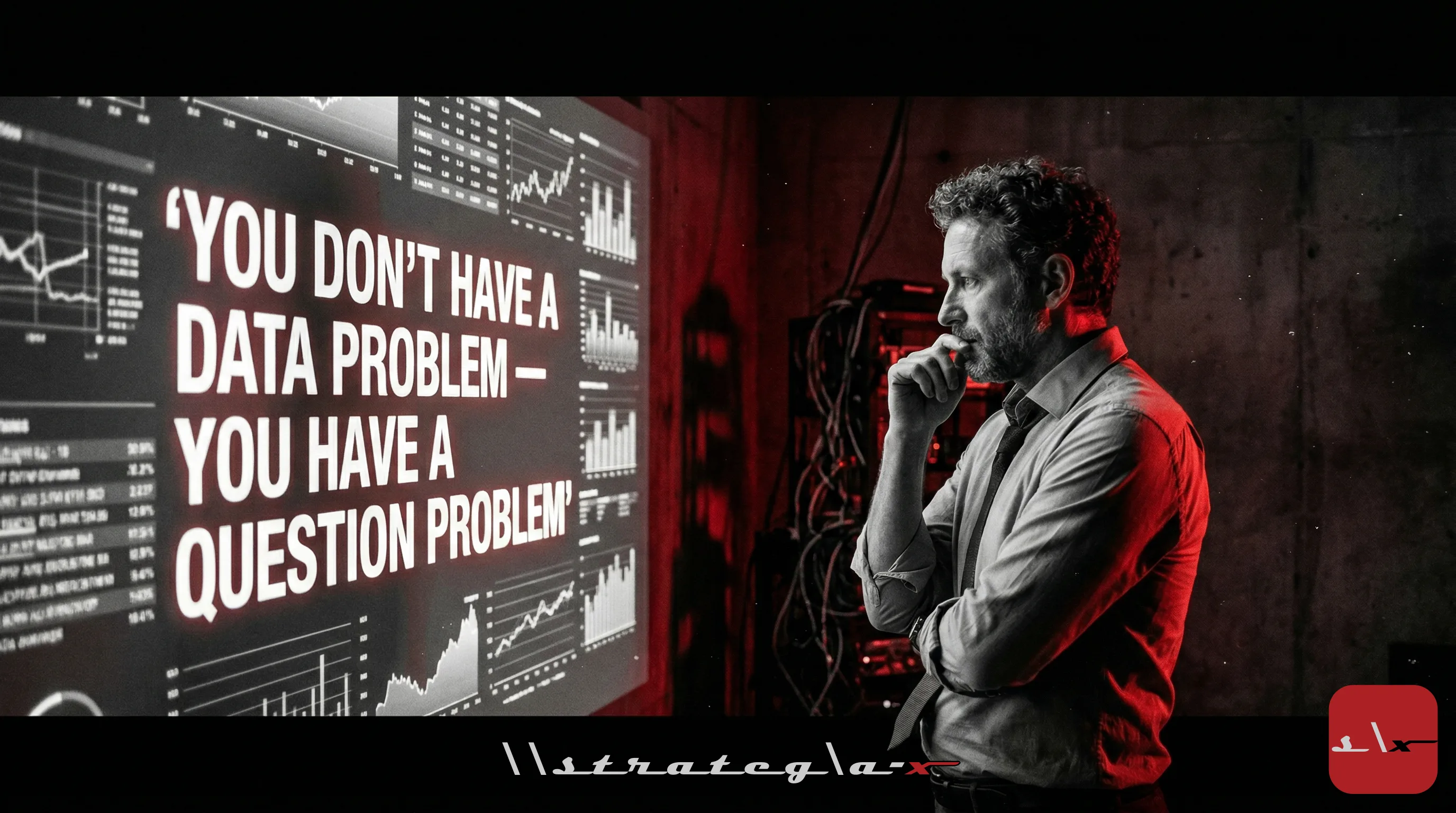
You don't have a data problem. You have a question problem. And until you fix it, every dollar you spend on analytics infrastructure is money you're lighting on fire.
The Billion-Dollar Industry That Can't Deliver
The global big data analytics market was valued at $394.7 billion in 2025, according to Fortune Business Insights, and it's projected to nearly triple to $1.18 trillion by 2034. Companies are spending enormous sums on data warehouses, BI platforms, analytics teams, and AI-powered dashboards. The tools have never been more powerful. The platforms have never been more sophisticated.
And the failure rate has barely moved in a decade.
Gartner analyst Nick Heudecker famously revised Gartner's estimate that 60% of big data projects fail, stating the real number was "closer to 85 percent," as reported by TechRepublic. The Wavestone Data and AI Leadership Executive Survey, the longest-running C-suite survey on data strategy, found that 78% of Fortune 1000 respondents still cite culture, people, and process as the primary barrier to becoming data-driven. Not technology. Not tools. Not data volume. People who never learned to ask the right questions.
We're spending hundreds of billions of dollars on answers. Nobody is investing in the questions.
Dashboards Nobody Uses, Reports Nobody Reads
Here's a scene playing out in thousands of companies right now: an analytics team builds a dashboard. It has 47 KPIs, beautiful charts, drill-down capability, real-time data refresh, and a color scheme that would make a design agency jealous. It gets presented to the leadership team. Everyone nods approvingly. "This is great," says the VP of Operations. "Really powerful stuff."
Then nobody logs into it again.
Forrester research has noted that only about 20% of business users actively self-serve their BI needs. The other 80% either don't use the tools at all or rely on someone else to pull numbers for them, numbers they may or may not act on. The dashboards aren't failing because they're poorly built. They're failing because they were built to display data, not to answer a question that drives a decision.
There's a fundamental difference between "here's what happened" and "here's what we should do about it." Most analytics initiatives stop at the first part and assume the second part will happen automatically. It doesn't. A dashboard showing monthly revenue trends tells you revenue went up or down. It doesn't tell you why, and it doesn't tell you what to change. That requires a question, articulated before the first chart was ever built, like: "Which customer segments are churning fastest, and what intervention would retain them?" That's a question that drives a decision. "Revenue by month" is just a number on a screen.
The Collect-Everything Trap
The default analytics strategy at most organizations is to collect everything. Every click, every transaction, every sensor reading, every log file. The reasoning sounds logical: if we capture all the data now, we'll be able to analyze it later when we need it. Data is the new oil, after all. You can never have too much.
Yes, you can. You can have so much that nobody knows what's relevant. You can have so much that your analysts spend 80% of their time cleaning, organizing, and wrangling data, and 20% actually analyzing it. You can have so much that the signal drowns in the noise, and the dashboards become so dense with metrics that they communicate nothing at all.
Harvard Business Review highlighted that companies lose an average of $15 million per year due to poor data quality alone, citing Gartner research. And the problem isn't just bad data, it's irrelevant data. Data collected without a purpose becomes a liability, not an asset. It consumes storage, requires governance, creates security risk, and, worst of all, creates the illusion of insight where none exists. Leaders see a data warehouse full of terabytes and assume they must be data-driven. They're not. They're data-hoarding. There's a difference.
The question-first approach flips this entirely. Instead of asking "what data can we collect?" you ask "what decision do we need to make, and what data would inform that decision?" The first approach gives you a data lake. The second gives you a decision engine.
Why the "Data-Driven" Vision Keeps Stalling
McKinsey's landmark research found that data-driven organizations are 23 times more likely to acquire customers, 6 times more likely to retain them, and 19 times more likely to be profitable. Those numbers are staggering. They're also misleading, because they describe the tiny minority of companies that actually achieved data-driven status, not the vast majority who tried and failed.
The Wavestone survey tells the real story. For years, only about 20-24% of Fortune 1000 companies reported having established a data-driven culture. Even the most recent surveys show that roughly half of the largest companies in the world can't claim to be data-driven despite a decade of investment.
Why the gap between aspiration and reality? Because these companies invested in the infrastructure of data without investing in the discipline of questioning. They built the pipes but never decided what should flow through them. They hired data scientists who can build brilliant models but gave them no clear business question to model against. The data scientists end up doing exploratory analysis, interesting, occasionally useful, but disconnected from the decisions that move the business.
The Question Framework That Actually Works
Every analytics initiative should start with four questions, and none of them are about data:
- What decision are we trying to make? Not "what do we want to know", what are we going to do with the answer? If you can't articulate a specific action that will change based on the analysis, you don't need the analysis. You want a report.
- Who is the decision-maker? Analytics without an owner is analytics without accountability. If nobody is responsible for acting on the insight, the insight dies in an inbox. Name the person. Make it explicit.
- What would change our mind? Before you look at data, define the threshold. "If customer churn exceeds 8% in the enterprise segment, we'll invest in a dedicated retention team." That's a decision criterion. Without it, you'll look at the data, debate what it means for three meetings, and do nothing.
- How often does this decision recur? A one-time strategic decision needs a one-time deep analysis. A recurring operational decision needs an automated dashboard. Building a real-time dashboard for a decision you make once a year is waste. Running a manual analysis every week for a decision you make daily is also waste. Match the tool to the cadence.
This framework takes 30 minutes in a room with the right stakeholders. It saves months of wasted analytics work. And it ensures that every dashboard, every report, and every model is connected to a decision that matters.
Start With the Decision, Not the Data Warehouse
The companies that get analytics right don't start with technology. They start with a decision inventory. They catalog the 20 or 30 most important decisions the business makes, pricing decisions, hiring decisions, inventory decisions, marketing allocation decisions, product prioritization decisions, and they work backward from each decision to the data that would improve it.
This approach produces radically different outcomes. Instead of a 47-KPI dashboard that nobody uses, you get a focused view showing the three metrics that determine whether to increase inventory for Q4. Instead of a monthly report with 15 pages of charts, you get an automated alert that fires when customer acquisition cost exceeds the threshold that makes a channel unprofitable. Instead of a data science team running exploratory analyses that produce interesting PowerPoints, you get models that are embedded directly into the decision-making process, predicting which deals will close, which customers will churn, which suppliers will miss delivery windows.
Harvard Business Review's research on data-driven decision-making failures makes this point precisely: the problem isn't a lack of data or analytical capability. It's a disconnect between what gets measured and what matters. Organizations focus on outcomes that are easy to measure rather than outcomes that drive the business. Starting with the decision, not the data, closes that gap entirely.
The Bottom Line
The analytics industry has a dirty secret: most of the money spent on data platforms, BI tools, and analytics teams produces no measurable business value. Not because the technology is bad. Not because the data scientists aren't talented. Because nobody started by asking the only question that matters: "What decision will this help us make?"
Stop building dashboards and start building decision frameworks. Stop collecting data and start defining questions. Stop measuring what's easy and start measuring what matters. The companies that win with analytics aren't the ones with the biggest data warehouses or the most sophisticated BI platforms. They're the ones that walked into the room, identified the 20 decisions that drive their business, and built their entire analytics strategy around making those decisions better. Every dashboard should answer a question. Every report should inform a decision. Every model should change an outcome. If it doesn't, it's not analytics, it's expensive decoration.
-Rocky
#Analytics #Datastrategy #Digitaltransformation #Businessintelligence #Datadriven #Smb #Decisionmaking #EngineeringDreams #StrategiaX