
The Subscription That Isn't a Strategy
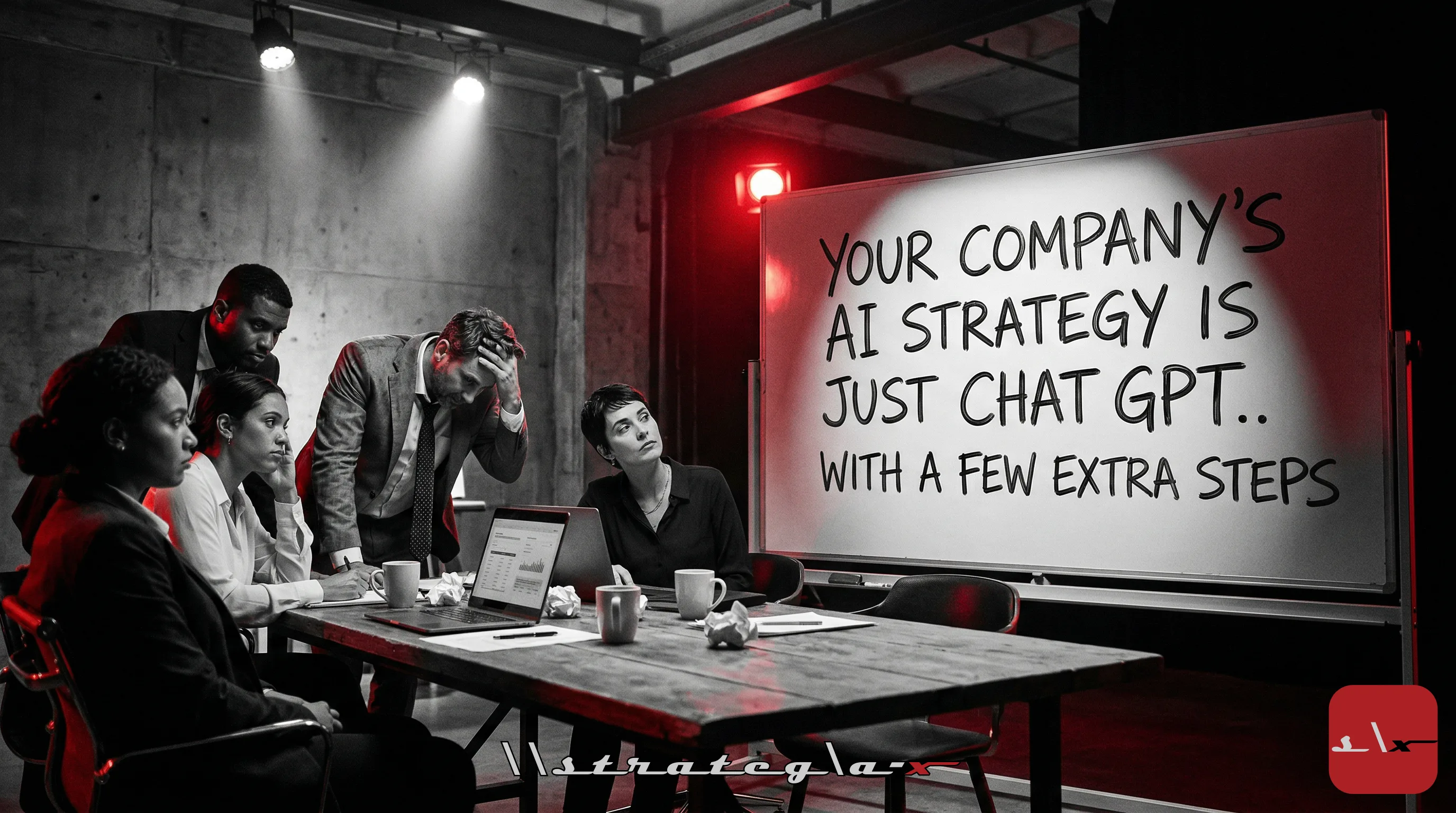
Let me be blunt: if your company's "AI strategy" is a Slack message that says "we got everyone ChatGPT Plus accounts," you don't have a strategy. You have a subscription. And that distinction is about to cost you, in wasted budget, in competitive positioning, and in the organizational whiplash that comes when leadership finally asks, "so what exactly did we get for all this?"
I watch this pattern repeat across dozens of companies. Somebody in the C-suite reads a breathless LinkedIn post about AI transformation, panics, and throws money at the most visible solution, usually ChatGPT, Copilot, or some vendor's "AI-powered" dashboard. Six months later, adoption is scattered, ROI is unmeasurable, and the whole initiative quietly gets filed under "innovation theater." Meanwhile, BCG found that only 5% of companies are seeing real returns on their AI investments, while 60% report little to no benefit despite substantial spending. That's not a technology problem. That's a strategy problem.
The Subscription-as-Strategy Trap
Here's what most small and mid-sized businesses actually did in the last two years: they bought AI tools. Not built AI capabilities, bought tools. There's a canyon between those two things, and most companies are standing on the wrong side of it.
Giving your team ChatGPT access and calling it an AI strategy is like buying a gym membership and calling it a fitness plan. The membership isn't the hard part. The hard part is showing up consistently, having a program, tracking progress, and adjusting when something isn't working.
According to Gartner's research, 30% of generative AI projects are abandoned after proof of concept, and that number is climbing. Why? Because most organizations jump straight to tools without doing the foundational work that makes those tools actually useful. They skip the boring parts, the data cleanup, the process mapping, the governance frameworks, because those things don't demo well in a board meeting.
Your Data Is a Mess (And That's the Real Problem)
Every AI vendor on the planet will tell you their product is plug-and-play. None of them will mention that plug-and-play assumes you have clean, structured, accessible data, which almost nobody does.
A Gartner study found that through 2026, organizations will abandon 60% of AI projects unsupported by AI-ready data. Let that number sink in. Sixty percent. Not because the AI didn't work, but because the data feeding it was garbage. Meanwhile, 63% of organizations either don't have or aren't sure they have the right data management practices for AI.
This is where SMB AI adoption hits a wall every single time. Your customer data lives in three different CRMs. Your financial records are split between QuickBooks and a spreadsheet Karen in accounting has been maintaining since 2019. Your operational data is trapped in systems that don't talk to each other. You can throw the most sophisticated AI model in the world at that mess and you'll get exactly what you put in: garbage, but faster.
Harvard Business Review Analytic Services confirmed this reality: while 94% of organizations are exploring or implementing AI, only 15% consider their data foundation "very ready" for advanced AI use cases. That gap isn't a speed bump, it's a chasm.
The Five Pillars of an Actual AI Strategy
If ChatGPT-with-extra-steps isn't a strategy, what is? A real AI strategy for any business, especially SMBs, needs five non-negotiable foundations:
- Clean data foundations. Consolidate your data sources. Standardize formats. Eliminate duplicates. Build pipelines that keep data fresh. This isn't glamorous work, but it's the foundation everything else depends on.
- Process integration, not tool bolting. AI should be woven into existing workflows, not stapled on top of them. McKinsey's 2025 research found that the single strongest predictor of enterprise-level AI impact is whether an organization fundamentally redesigned its workflows, and only 21% of companies have done this.
- Governance and risk frameworks. Who owns AI decisions? What guardrails exist for sensitive outputs? How do you handle hallucinations, bias, or compliance violations? If you can't answer these questions, you're running without brakes.
- Clear use cases tied to business outcomes. "Use AI to be more efficient" is not a use case. "Reduce customer response time by 40% using AI-assisted ticket routing" is. Every AI initiative needs a measurable objective and a timeline.
- Organizational readiness and talent. Your team needs to understand what AI can and can't do. They need training, not just tool access.
Why the "Just Buy Tools" Approach Fails at Scale
The tool-first approach works fine for individual productivity. A marketer using ChatGPT to draft email subject lines? Great. A developer using Copilot to autocomplete boilerplate? Useful. But individual productivity gains don't compound into organizational transformation without a system connecting them.
BCG's analysis of over 1,250 global firms reveals a widening value gap: companies that redesigned their operations around AI are seeing twice the revenue increase and 40% greater cost reductions compared to those that simply adopted tools. The difference isn't which AI they're using, it's how deeply they've integrated it.
McKinsey's data is even more stark. Out of nearly 2,000 organizations surveyed, only about 5.5% qualify as "AI high performers", companies where AI contributes more than 5% of EBIT. These high performers aren't using fancier models. They're doing the organizational work: redesigning workflows, investing 20%+ of digital budgets in AI, and, critically, pursuing transformational change rather than just efficiency gains.
The SMB Advantage Nobody Talks About
Here's the contrarian take: SMBs actually have a structural advantage in AI strategy that most of them are wasting. Large enterprises struggle with AI because they have massive legacy systems, political fiefdoms protecting data silos, and change management nightmares spanning thousands of employees. You don't have those problems.
A 50-person company can consolidate its data in weeks, not years. You can redesign a workflow in a sprint, not a fiscal quarter. You can train your entire team in a month, not a multi-year change management initiative. The agility that defines SMBs is exactly what AI strategy rewards, if you actually use it strategically instead of just subscribing to tools.
The problem is that most SMBs are mimicking enterprise behavior, buying what big companies buy, copying what LinkedIn influencers recommend, instead of leveraging their speed advantage. Stop trying to build a Fortune 500 AI stack. Start by picking one process that's costing you the most time or money, getting the data right for that process, and proving value before expanding.
What Hitting the Wall Actually Looks Like
Companies that skip the strategic foundation don't just plateau, they actively regress. Here's the pattern I see repeatedly:
- Months 1-3: Excitement. Everyone's using ChatGPT. Productivity feels like it's up. Leadership celebrates the "AI transformation."
- Months 4-8: Novelty wears off. Usage becomes sporadic. Different teams use different tools in incompatible ways. Nobody's measuring anything. The "AI champions" burn out.
- Months 9-12: CFO asks about ROI. Nobody can produce numbers because there were never baseline metrics. Leadership quietly cuts budgets. Team becomes cynical about the next "transformation initiative."
Accenture's research found that only 8% of organizations qualify as "front-runners" who have successfully scaled multiple AI implementations. The wall isn't hypothetical, most companies are already running into it.
The Bottom Line
AI is not a product you buy. It's a capability you build. And building that capability requires the kind of disciplined, unsexy, strategic work that most companies skip because it doesn't make for good press releases. Clean your data. Map your processes. Define your governance. Pick specific use cases with measurable outcomes. Train your people, not just on tools, but on thinking critically about where AI creates value and where it creates risk.
Buying ChatGPT is not an AI strategy. Building the organizational muscle to leverage AI across your business, with clean data, integrated processes, real governance, and measurable outcomes, is. The 95% of companies still stuck in tool-buying mode are about to learn this lesson the expensive way. The gap between companies that built AI capabilities and companies that bought AI subscriptions is already widening, and it's about to become unclosable.
-Rocky
#Aistrategy #Artificialintelligence #Technologytrends #Digitaltransformation #Smb #Innovation #Datastrategy #EngineeringDreams #StrategiaX