
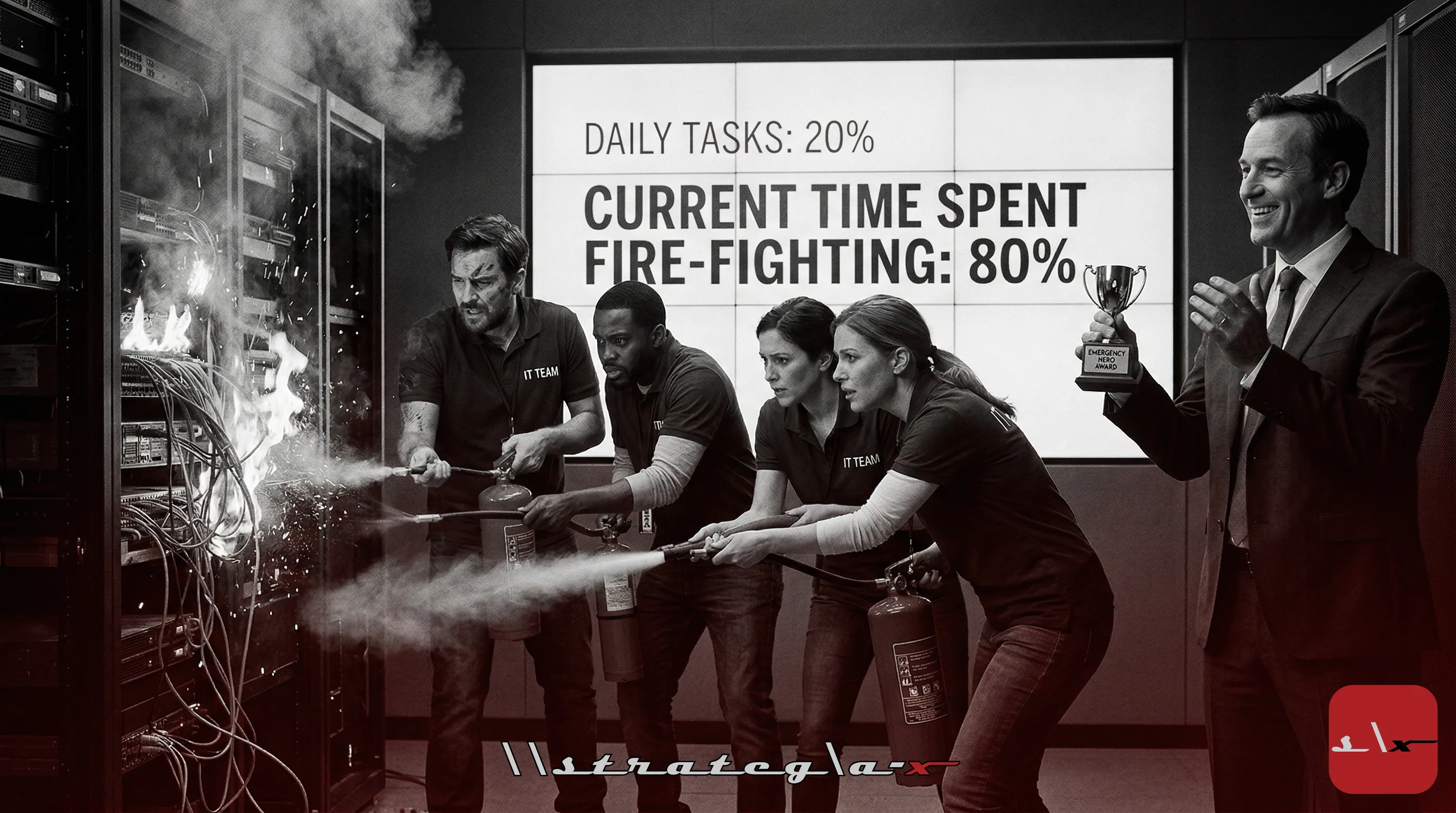
The Hero Culture That's Destroying Your IT Team
Let me paint a picture you'll recognize immediately. It's Tuesday at 2:47 PM. A critical application goes down. Your IT team scrambles. Slack channels explode. Someone pulls an all-nighter, duct-tapes a fix together, and by Wednesday morning, everything is "back to normal." The CTO sends a company-wide email praising the team's heroic effort. Maybe there's pizza. Everyone feels great about how the team "stepped up."
Here's what nobody asks: why did it break in the first place? And why does this exact scenario play out every two weeks like clockwork? Because your organization has built a system that rewards firefighting, and that system is eating your IT budget alive.
The Numbers Don't Lie, Your Team Is Stuck in Reactive Mode
According to PagerDuty's State of Unplanned Work Report, more than 81% of IT professionals agree that urgent, unplanned work keeps their company from focusing on key objectives. That's not a small inconvenience. That's a strategic catastrophe. The same report found that 62% of IT professionals in North America spend more than 100 hours per year on disruptive, unplanned work, and for a typical mid-market IT team of six to eight people, that translates to nearly two full days per week spent on firefighting.
Read that again. Two days a week. That's 40% of your IT team's capacity burned on things that shouldn't be happening in the first place. Meanwhile, DORA's 2024 State of DevOps Report shows that elite-performing teams deploy multiple times per day with change failure rates as low as 5%, recovering from failures in under an hour. Low performers? They're taking up to six months to recover from a failed deployment. The gap between reactive and proactive IT isn't incremental, it's an order of magnitude.
The Hero Trap: Why You're Incentivizing the Wrong Behavior
Here's the uncomfortable truth that most leadership teams don't want to hear: you've built a reward system that makes firefighting rational. The engineer who stays up until 3 AM to fix a production outage gets a shout-out in the all-hands meeting. The engineer who quietly spent three weeks building monitoring and automation that would have prevented the outage entirely? Nobody notices. Nobody claps. There's no dopamine hit for preventing a crisis that never happens.
This isn't just an anecdote. ISACA's 2024 analysis of IT hero culture documents how this pattern creates a self-perpetuating cycle: organizations that depend on individual heroics develop knowledge silos, operational fragility, and increased IT failures. The business comes to expect that "passionate workers will always put in the extra hours," which justifies understaffing and underinvesting in infrastructure. Heroes burn out, leave, and take all the institutional knowledge with them. Then you hire replacements who inherit the same broken systems and start the cycle again.
47% of engineers tie burnout directly to DevOps overload, and 64% report that repetitive infrastructure tasks drain their energy and creativity. You're not just wasting money on reactive work, you're burning through your most valuable people.
The Real Cost of Reactive IT
Let's talk dollars. Gartner's research pegs the average cost of IT downtime at $5,600 per minute, roughly $300,000 per hour. For larger enterprises, Atlassian's analysis of downtime costs notes that 40% of enterprises report a single hour of downtime costs between $1 million and $5 million. But the direct cost of an outage is only the tip of the iceberg. The real damage is opportunity cost, every hour your team spends chasing yesterday's fire is an hour they're not spending on:
- Automating deployments to reduce future incidents
- Building monitoring that catches problems before users do
- Modernizing infrastructure to reduce technical debt
- Implementing security hardening before a breach forces you to
- Evaluating new tools and platforms that could cut costs
Puppet and DORA's State of DevOps research quantified this precisely: high-performing organizations spend 22% less time on unplanned work and rework, which allows them to spend 29% more time on new features and innovation. That 29% isn't just a nice-to-have. Over a year, it's the difference between a team that ships competitive products and a team that's perpetually treading water.
What Elite IT Teams Actually Look Like
The best IT operations I've ever seen are boring. Nothing is on fire. Nobody's pulling all-nighters. There's no adrenaline, no drama, no war stories. And that's exactly the point. Here's what proactive IT teams do differently:
- They invest in observability before incidents happen. Monitoring, alerting, and dashboards aren't afterthoughts, they're the foundation.
- They run blameless postmortems religiously. Not to punish, but to learn. Every incident is a data point, not a blame game.
- They automate the boring stuff. Deployments, rollbacks, scaling, patching, if a human is doing it manually, it's a liability.
- They practice chaos engineering. They break things on purpose, under controlled conditions, so they know exactly what happens when things break for real.
- They measure the right things. Not "how fast did we fix it" but "why did it break" and "what did we do to make sure it never breaks this way again."
How to Break the Firefighting Cycle
Shifting from reactive to proactive IT isn't a technology problem. It's a leadership problem. The technology exists. The frameworks exist. What's usually missing is the organizational will to stop rewarding heroics and start rewarding prevention. Here's the playbook:
First, measure your unplanned work ratio. Track what percentage of your IT team's time goes to planned versus unplanned work. If it's above 30% unplanned, you have a structural problem, not a staffing problem. Throwing more bodies at a broken process just gives you more people fighting fires.
Second, change what you celebrate. Start recognizing the engineer who builds the automation that prevents outages. Highlight the team that reduced alert volume by 40%. Make "boring" the aspiration. When nothing breaks, that's the standing ovation moment.
Third, enforce postmortem discipline. Atlassian's 2024 State of Incident Management Report found that only 22% of companies practice blameless postmortems. The other 78% are either not doing postmortems at all or conducting blame-filled ones that ensure nobody ever surfaces the real root cause again. Fix this immediately.
Fourth, protect capacity for proactive work. Block 20-30% of your team's sprint capacity for infrastructure improvements, automation, and technical debt reduction. Treat this time as sacred, not as slack that can be stolen when the next fire starts.
Fifth, invest in automation ruthlessly. Every repetitive manual process is a future incident waiting to happen. Automate deployments, patching, backups, and monitoring responses. The upfront investment pays for itself within a single prevented outage.
The Bottom Line
Your IT team isn't firefighting because they're bad at their jobs. They're firefighting because you've built an organization that makes firefighting the rational choice. You reward crisis response over crisis prevention. You celebrate the hero who stayed up all night instead of asking why anyone needed to. You underfund proactive infrastructure because the ROI of "nothing went wrong" is invisible on a spreadsheet.
The best IT organizations in the world are boring, and that's exactly how it should be. Stop celebrating fires. Start celebrating the teams that make fires impossible. Because every dollar you spend on reactive IT is a dollar you're not spending on the work that actually moves your business forward. The question isn't whether you can afford to invest in proactive IT operations. The question is how much longer you can afford not to.
-Rocky
#Itstrategy #Itoperations #Firefighting #Proactiveit #Infrastructure #Smb #Devops #EngineeringDreams #StrategiaX