The Culture That Was Never There
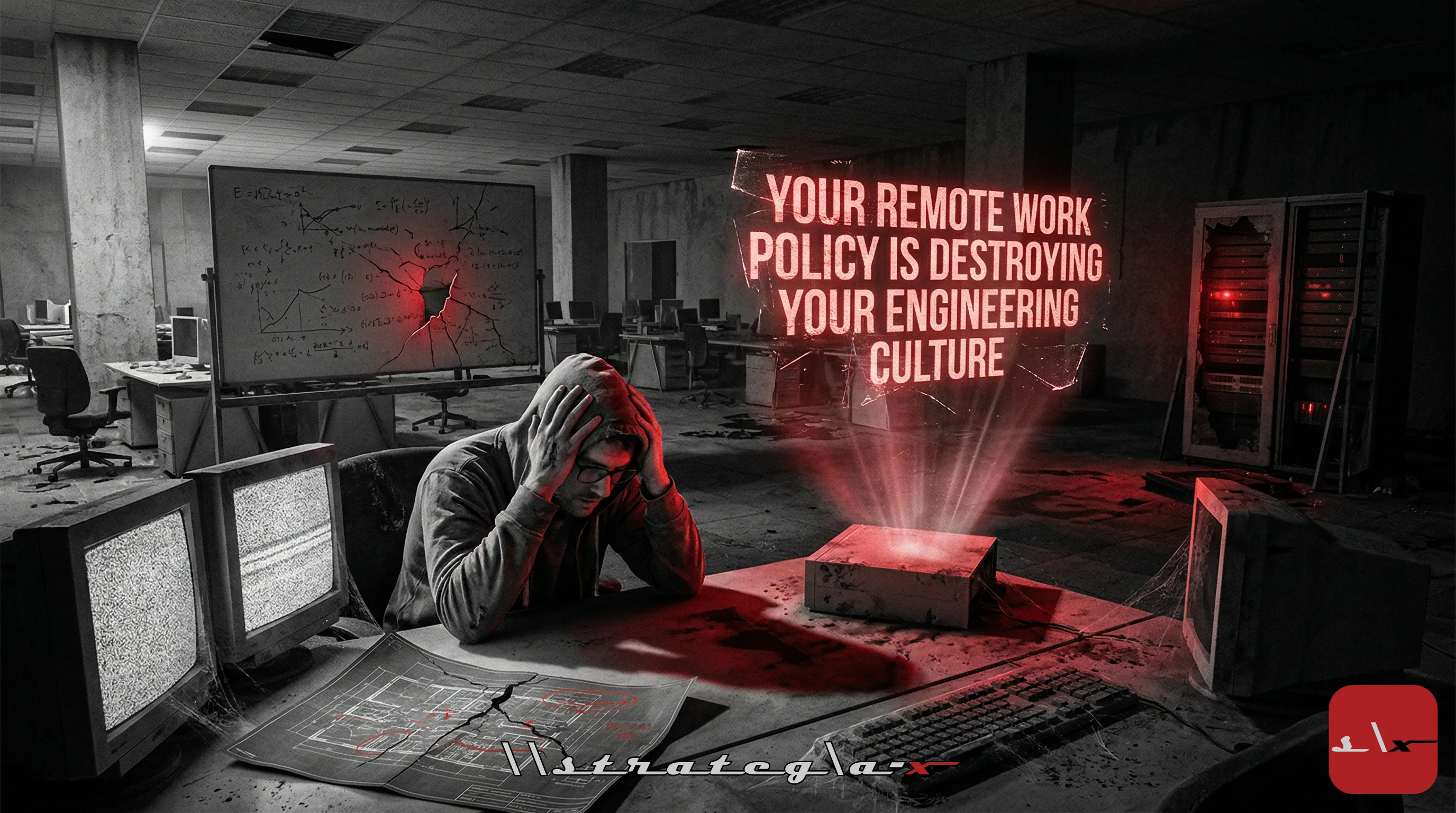
Let me be blunt: the loudest voices in the return-to-office debate are wrong. Not because remote work is perfect, it isn't. But because they're diagnosing the wrong disease. They see declining cohesion, evaporating mentorship, and a growing sense that "something feels off" in their engineering teams, and they conclude that remote work is the problem. It's not. The absence of intentional culture design is the problem. Remote work just made it impossible to ignore.
Here's what nobody wants to admit: most companies never actually had engineering culture. They had proximity. Engineers sat near each other, overheard conversations, absorbed context through osmosis, and everyone called it "culture." Then remote work stripped away the proximity, and the thing they mistook for culture vanished overnight. Now they want everyone back in the office so they can pretend it exists again.
The Productivity Red Herring
Every return-to-office memo cites productivity concerns. And every piece of credible research says those concerns are largely unfounded. Microsoft's Work Trend Index has consistently shown that individual productivity metrics either hold steady or increase in remote settings. Engineers write code. They close tickets. They ship features. The measurable output is there.
Buffer's State of Remote Work report found that the vast majority of remote workers report being as productive or more productive than in the office. And 98% of respondents said they'd like to work remotely at least some of the time for the rest of their careers. That's not a preference, that's a mandate from your talent pool.
So if productivity isn't the problem, what is? The answer is everything that happens between the measurable outputs, the invisible connective tissue that turns a collection of productive individuals into an actual engineering team.
The Real Casualty: Ambient Knowledge Transfer
In a physical office, an enormous amount of learning happens by accident. A junior engineer overhears a senior architect explaining a design decision to someone else. A developer walks past a whiteboard and notices a system diagram that changes how they think about a problem. Someone mentions a production incident at lunch, and three people who weren't involved now understand a failure mode they'd never considered.
This isn't trivial. This ambient knowledge transfer is the primary mechanism by which engineering organizations build shared mental models. It's how institutional knowledge propagates. It's how engineers develop judgment, not just skill. And in a remote environment, it simply does not happen unless you deliberately engineer it to happen.
Research published in Harvard Business Review has highlighted the growing disconnect between how managers and employees perceive remote work effectiveness, with collaboration and knowledge sharing consistently ranking among the top concerns. The data doesn't say remote can't work. It says remote without intentional design creates invisible gaps that compound over time.
Mentorship Doesn't Scale Over Slack
Ask any senior engineer how they learned to be good at their job, and they'll tell you stories about people, not documentation. The tech lead who pulled them aside after a code review and spent 30 minutes explaining why a design choice mattered. The architect who invited them to sit in on a system design meeting they had no business attending. The principal engineer who noticed they were struggling and offered help without being asked.
Mentorship at its best is spontaneous, contextual, and relationship-driven. It requires the mentor to notice things, confusion, frustration, a missed opportunity for growth, and respond in real time. In a remote environment, all of that requires explicit effort. The mentor has to schedule a call. The mentee has to admit they're struggling in writing. The serendipity is gone.
Gallup's research on hybrid work has found that employees who feel their organization cares about their development are significantly more engaged, and that remote workers are more likely to feel disconnected from development opportunities. This isn't a remote work problem. It's a design problem. And most companies aren't designing for it at all.
The Companies Getting It Right
Here's the part that the "return to office" crowd doesn't want to hear: some remote-first companies have stronger engineering cultures than most office-based teams. They just had to build it on purpose instead of getting it for free.
GitLab's public handbook is the gold standard example. With over 2,000 pages of documented processes, decisions, and cultural norms, they've turned implicit knowledge into explicit knowledge at a scale most office-based companies can't match. Their engineering culture isn't weaker because they're remote, it's arguably stronger because they were forced to codify what most companies leave to chance.
What these companies have in common isn't a magic tool or a clever policy. It's intentionality. They've designed specific mechanisms to replace what proximity used to provide for free:
- Structured documentation culture, Architecture Decision Records, design docs, and post-mortems that capture the reasoning behind decisions, not just the decisions themselves
- Deliberate overlap rituals, Pair programming sessions, virtual "office hours" with senior engineers, and recorded design reviews that anyone can watch asynchronously
- Ambient channels, Dedicated Slack channels where engineers share what they're working on, what they're stuck on, and what they've learned, creating a digital version of overhearing conversations
- Intentional onboarding, Multi-week structured programs that actively build relationships and expose new hires to how the team thinks
- Asynchronous-first communication, Defaulting to long-form written communication that creates a searchable, permanent knowledge base
What Intentional Remote Culture Actually Looks Like
If you're a leader, especially at an SMB where you can't throw unlimited resources at this, here's what actually works:
- Write everything down. Every decision, every architectural choice, every process change. If it wasn't documented, it didn't happen. This is the single highest-leverage change you can make.
- Make mentorship explicit. Assign mentors. Schedule regular 1:1s. Create structured programs for junior engineers. Don't rely on osmosis that no longer exists.
- Create spaces for serendipity. Weekly informal video calls with no agenda. Cross-team demo days. Shared channels where engineers post interesting things they've learned. You're manufacturing the collisions that offices provided naturally.
- Default to async, reserve sync for high-bandwidth communication. Most meetings should be documents. Save real-time interaction for brainstorming, relationship building, and complex problem-solving where tone and nuance matter.
- Record and share everything. Design reviews, incident retrospectives, architecture discussions, record them and make them searchable. The junior engineer who joins in six months should be able to understand why you made the choices you made.
- Measure what matters. Stop measuring hours online or response times. Measure knowledge sharing, documentation quality, mentorship outcomes, and cross-team collaboration.
The Bottom Line
The remote work debate is a distraction. The real question isn't "where should engineers work?", it's "have we actually built an engineering culture, or were we just relying on proximity to fake one?" Most companies will never ask that question because the answer is uncomfortable. They'd rather mandate three days in the office and pretend the problem is solved.
Remote work didn't kill your engineering culture. It revealed that you never built one. The fix isn't dragging people back to the office, it's doing the hard work of intentional design that you should have been doing all along. Build the documentation. Design the rituals. Invest in the relationships. The companies that do this will attract the best talent, retain them longer, and build things that matter. The ones that don't will keep blaming Zoom for problems that existed long before anyone worked from home.
-Rocky
#Remotework #Engineeringculture #Leadership #Teammanagement #Hybridwork #Smb #Talentretention #EngineeringDreams #StrategiaX