The Productivity Paradox Nobody Wants to Talk About
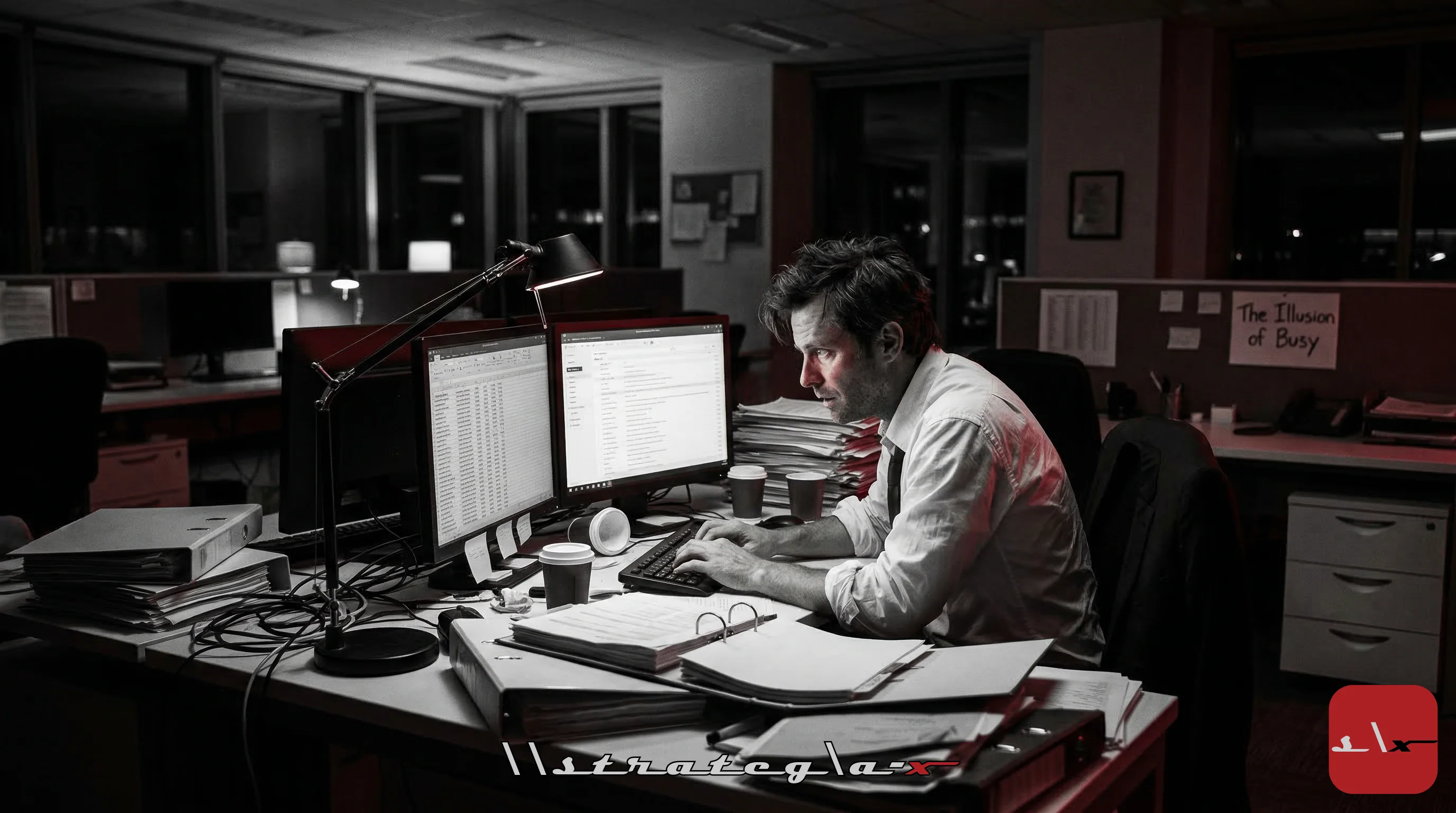
Your team is working harder than ever. Calendars are packed. Slack channels are buzzing. Emails are flowing at all hours. Laptops open at 7 AM, closed at 9 PM. Everyone looks busy. Everyone feels busy.
So why isn't the needle moving?
Here's the uncomfortable truth that most leaders avoid confronting: activity is not output. Busyness is not productivity. And the team that logs 60-hour weeks while shipping the same results as a focused 35-hour team doesn't have a work ethic advantage, they have a systems failure.
A study by Stanford economist John Pencavel found that productivity per hour drops sharply after 50 hours per week, and output at 70 hours is nearly identical to output at 55. Your team isn't producing more by working longer. They're producing the same amount, slower, while burning out in the process.
The illusion of busy is one of the most expensive problems in business. And most companies don't just tolerate it, they reward it.
How Busyness Culture Actually Works
Busyness culture doesn't happen by accident. It's the natural result of organizations that measure presence and activity instead of outcomes and impact. And it manifests in predictable, measurable ways:
1. Meeting Theater
The average knowledge worker spends 31 hours per month in unproductive meetings. That's nearly four full working days, every month, consumed by conversations that produce no decisions, no actions, and no value. But they look productive. Calendars full of meetings signal importance. Being "in meetings all day" has become a status symbol rather than the red flag it actually is. When someone says "I've been in meetings since 8 AM," the implicit message is "I'm important and in demand." The actual message should be: "I've produced nothing of value today."
2. Performative Email
Reply-all culture. The CC chain that includes six people who don't need to be there. The 11 PM email sent primarily to signal dedication. The email that could have been a two-line Slack message but instead became a 400-word essay because longer emails feel more substantial. Research from McKinsey found that the average professional spends 28% of their workweek managing email. For a team of 25, that's the equivalent of 7 full-time employees doing nothing but email all day, every day.
3. Status Update Addiction
Daily standups that take 45 minutes. Weekly status reports that take 2 hours to compile and 5 minutes to skim. Monthly reviews of metrics that nobody acts on. Progress tracking that consumes more time than the work being tracked. When the overhead of reporting on work exceeds a meaningful fraction of the work itself, you haven't built accountability. You've built a bureaucracy that punishes efficiency, because the person who finishes in 2 hours has less to report than the person who stretches it to 8.
4. Urgency Addiction
Everything is urgent. Every request is ASAP. Every ticket is high priority. When everything is on fire, the team operates in permanent reactive mode, bouncing between emergencies, never getting ahead, always feeling behind. But it feels productive. Fighting fires feels like real work. The dopamine hit of solving an urgent problem is immediate and tangible. The slow, boring, strategic work that prevents fires doesn't feel like anything, which is why it never gets done, which is why everything stays on fire.
The Real Cost of False Productivity
This isn't just a cultural annoyance. It has measurable financial consequences.
A team of 30 knowledge workers averaging $80,000 in salary represents $2.4 million in annual labor cost. If 40% of their time is consumed by performative activity instead of meaningful output, and research consistently shows this is conservative, that's $960,000 per year spent on the appearance of work instead of actual work.
Nearly a million dollars. Not on salaries. Not on benefits. On waste disguised as productivity.
But the damage goes beyond dollars:
- Talent loss: Your best performers, the ones who actually care about output, are the first to leave busyness cultures. They recognize that the system rewards theater over results, and they go somewhere that values their actual work.
- Innovation death: Creative thinking requires slack time. Unstructured time. Time to think without producing a deliverable. Busyness culture eliminates that time entirely, replacing it with meetings, emails, and status updates. The result is a team that executes but never innovates.
- Decision degradation: Leaders buried in activity don't have the cognitive bandwidth for strategic thinking. Decisions get made reactively, based on whatever is loudest, not whatever is most important.
The Shift: From Activity-Based to Outcome-Based Management
Fixing this requires a fundamental shift in how you define and measure productivity. Not hours logged. Not meetings attended. Not emails sent. Outcomes delivered.
1. Define What "Done" Actually Means
For every role, every project, every initiative, define the specific, measurable outputs that represent real value. A developer's output isn't lines of code or hours online. It's features shipped, bugs resolved, and system reliability. A marketer's output isn't campaigns launched or emails sent. It's qualified leads generated and pipeline influenced. When you define outcomes clearly, activity-based performance becomes impossible to hide behind.
2. Audit Your Meeting Load
For one week, have every person on your team track every meeting they attend and answer three questions: Was a decision made? Was I necessary? Could this have been async? Most teams discover that 50-70% of their meetings fail at least one of these tests. Cancel those meetings. Protect that time. Watch output increase without a single additional hour of work.
3. Kill the Status Report
If your project management tool can't surface project status without a human compiling a report, you have the wrong tool. Modern project management platforms, Monday, Asana, Linear, Jira, provide real-time dashboards that make weekly status reports obsolete. The information is already in the system. Stop paying people to reformat it into a slide deck.
4. Create Maker Schedules
Paul Graham's concept of "maker's schedule vs. manager's schedule" is critical here. Makers, developers, designers, writers, analysts, need long, uninterrupted blocks to produce their best work. Managers need short, frequent interactions. Most companies force everyone onto a manager's schedule: fragmented days filled with 30-minute blocks. The result is that your makers spend more time in meetings about work than doing work. Give makers at least 4 consecutive hours of uninterrupted time daily. Cluster meetings into specific windows. The output difference is immediate and dramatic.
5. Reward Output, Not Optics
This is the hardest one because it requires changing what leadership pays attention to. Stop praising the person who's always online. Start praising the person who shipped the feature in half the estimated time and logged off at 4 PM. Stop rewarding the employee who sends the most emails. Start rewarding the one whose projects close on time, under budget, with minimal rework. When leadership visibly values outcomes over activity, the culture follows. When leadership rewards busyness, they'll get exactly that, and nothing more.
The Bottom Line
Your team isn't underperforming because they're not working hard enough. They're underperforming because the system is optimized for the appearance of work instead of the production of results.
Busyness is not a badge of honor. It's a symptom of broken systems, unclear priorities, and management that confuses motion with progress. The companies that win aren't the ones where everyone is busy. They're the ones where everyone is effective. Strip away the meeting theater, the performative email, the status report bureaucracy, and you'll find that your team has been sitting on 30-40% more capacity all along. They don't need to work more hours. They need fewer obstacles between them and their actual work.
-Rocky
#Productivity #Leadership #Teammanagement #Workculture #Operationalefficiency #Smb #Businessoperations #Timemanagement #Focuswork #EngineeringDreams #StrategiaX