The Software Graveyard Inside Your Organization
Walk through your software stack. Not the one on the vendor management spreadsheet, the one people actually use. Open the CRM. How many fields are populated? How many automations are running? How many users logged in last week versus how many have licenses? Now check the project management tool. Is it driving workflow, or is it a dumping ground where tasks go to be forgotten? Check the BI platform. When was the last time someone opened a report and made a decision based on it?
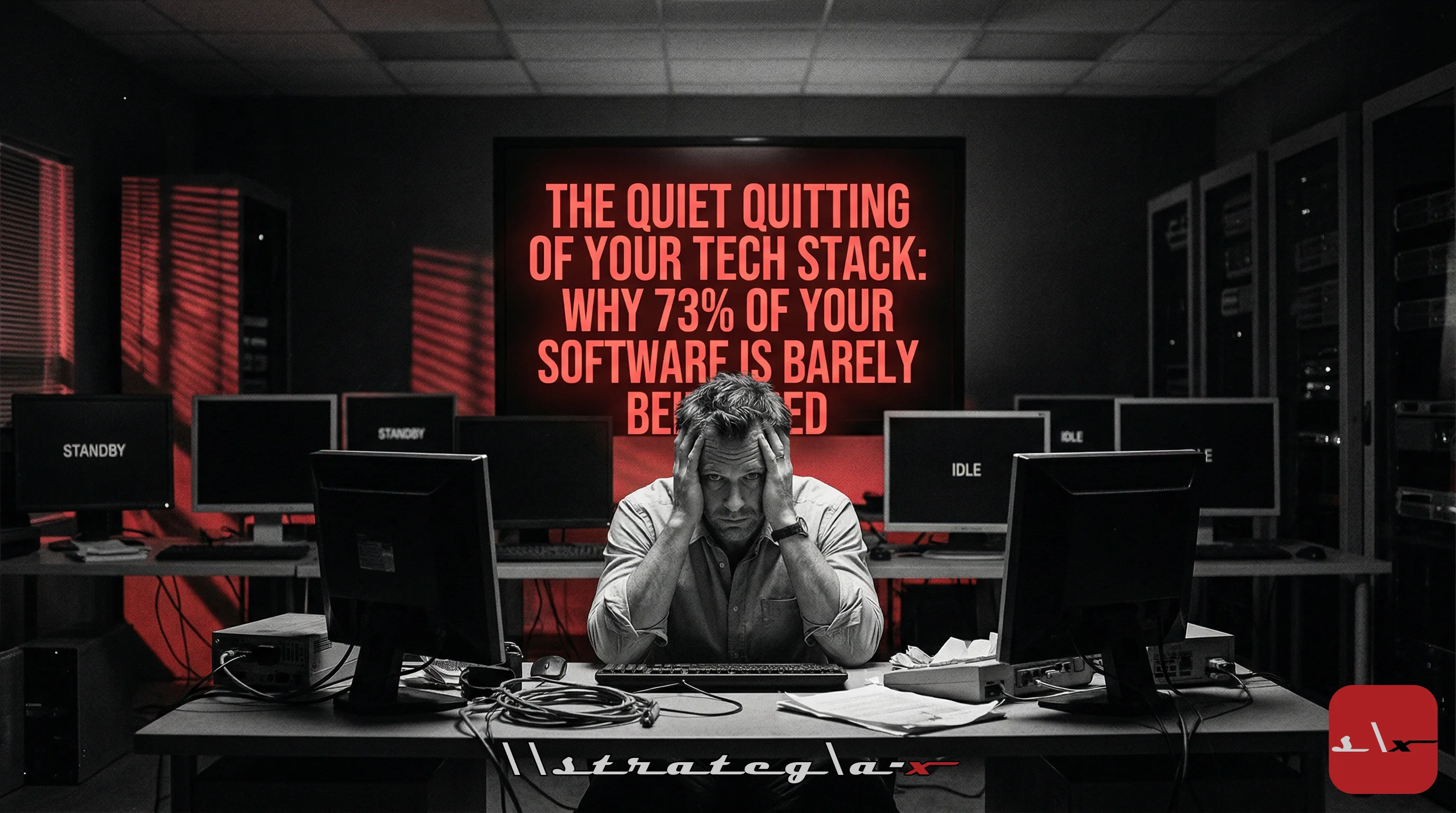
If you're honest with yourself, the answers are painful. Because across the enterprise software landscape, average feature adoption is only 20-30%. That means the average company is using less than a third of the capabilities they're paying for. Industry research shows that $600 billion is wasted globally each year on underutilized software licenses and features. Your company is contributing to that number. And it's not because the software is bad.
It's because rollout is not adoption. Implementation is not utilization. Deployment is not value creation. And most organizations confuse all three.
How Software Adoption Actually Fails
The pattern is remarkably consistent across industries, company sizes, and software categories:
Phase 1: The Grand Vision (Months 1-2)
Leadership identifies a problem. "We need better customer visibility." "We need project tracking." "We need data analytics." They evaluate tools. They see demos. They get excited about features. They imagine the transformation. The vendor shows a polished demo with perfect data, beautiful dashboards, and seamless workflows. Budget gets approved. License purchased. Vendor celebrates.
Phase 2: The Implementation Sprint (Months 3-5)
IT configures the platform. Data gets migrated, sort of. Integrations are built, partially. Custom fields are created based on what leadership thinks the team needs. Training sessions are scheduled. A one-hour webinar. Maybe a half-day workshop. "Here's how to log in. Here's where to click. Here's the support email if you have questions." The vendor marks the implementation as "complete." The project manager closes the ticket.
Phase 3: The Gradual Abandonment (Months 6-18)
Usage peaks in month one. By month three, daily active users have dropped 40%. The power users, usually 2-3 people, keep the system alive. Everyone else has reverted to email, spreadsheets, and the old way of doing things. The data in the system becomes stale because people stopped updating it. Reports become unreliable because incomplete data produces incomplete analysis. Leadership stops checking the dashboards because they don't trust the numbers. The software is technically deployed. Functionally, it's dead.
Phase 4: The Blame and Replace Cycle (Month 18+)
Leadership concludes the software "doesn't work" or "isn't a good fit." They start evaluating alternatives. The RFP goes out. A new vendor wins. The cycle repeats. Same organizational dynamics. Same training gaps. Same change resistance. Different logo on the login screen. Same result.
Why Rollout Is Not Adoption
The fundamental mistake is treating software deployment as a technology project. It's not. It's a change management project with a technology component. The technology is the easiest part. The hard part, the part that determines whether you get value from your investment, is changing how people work.
When you deploy a new CRM, you're not just giving people a new tool. You're asking them to change their daily workflow. You're asking them to enter data they didn't have to enter before. You're asking them to learn new interfaces when the old way was faster (at least for them, individually). You're asking them to trust a system they didn't choose and don't fully understand.
Without addressing these human factors, every software rollout follows the same trajectory: initial compliance, gradual resistance, eventual abandonment. The technology didn't fail. The change management did.
The Training Gap That Kills ROI
The average enterprise software training consists of a one-hour overview delivered during the launch week and a link to the vendor's help center. This is not training. This is an introduction, and it's wildly insufficient for driving actual behavior change.
Research from the Association for Talent Development found that organizations with comprehensive, ongoing software training programs see 218% higher adoption rates than those with one-time training events. The reason is simple: people don't learn software by watching a demo. They learn by doing, and they need support over weeks and months, not hours. Effective software training includes:
- Role-specific training: Sales doesn't need the same CRM training as customer support. The marketer needs different BI training than the CFO. Generic training wastes everyone's time and teaches nobody what they actually need.
- Workflow-based, not feature-based: Don't teach people features. Teach people workflows. "Here's how to log a new lead, qualify it, and move it through the pipeline" is useful. "Here's the contacts module, here's the deals module, here's the reports module" is a feature tour that nobody retains.
- Ongoing reinforcement: Monthly drop-in sessions. Weekly tips via Slack or email. Quarterly refreshers on underutilized features. Adoption is a habit, and habits require reinforcement.
- Just-in-time support: When someone gets stuck, they need help now, not after submitting a ticket and waiting 48 hours. Internal champions, dedicated Slack channels, and contextual in-app guidance keep people moving when they hit friction.
The Champion Model: Your Secret Weapon
The single most effective adoption strategy is the champion model. Identify 1-2 people per department who are naturally enthusiastic about the tool, or at least willing to learn it deeply. Invest heavily in training these champions. Give them advanced access, dedicated vendor support time, and recognition for their role. Then let them be the first line of support and advocacy within their teams.
Champions work because they're peers, not IT. When the VP of Sales sends an email saying "use the new CRM," the team complies reluctantly. When the senior account executive says "let me show you the dashboard I built, it saves me two hours a week," the team leans in. Peer influence drives adoption faster than executive mandates. Always.
Microsoft's internal research on Teams adoption found that departments with designated champions saw 3.5x faster adoption than those without. The champion didn't need to be a technical expert. They just needed to be a trusted peer who could translate the tool's capabilities into the team's daily reality.
How to Audit Your Actual Software Utilization
Before you buy another tool, audit what you already have. Most SaaS platforms provide admin analytics that show actual usage. Here's what to measure:
- License utilization: How many paid licenses versus active users? If you're paying for 50 seats and 22 people logged in last month, you're paying double what you should.
- Feature utilization: Which features are being used? Which have never been accessed? Most SaaS analytics dashboards can show you feature-level engagement. You may discover that you're paying for Enterprise tier when your usage matches the Basic plan.
- Data freshness: When was the last time data was updated in the system? Stale data is the clearest signal of abandonment. If nobody's updating the CRM, nobody's using the CRM, regardless of what login metrics show.
- Workflow completion rates: Are people starting workflows but not finishing them? That signals friction in the process, a step that's too complex, too slow, or too disconnected from their actual work.
- Integration health: Are integrations flowing data reliably? Broken integrations are the fastest way to kill adoption, because the moment people have to enter data twice, they stop entering it at all.
The Uncomfortable Truth: Sometimes You Bought the Wrong Tool
Not every adoption failure is a change management failure. Sometimes the tool genuinely doesn't fit. The CRM built for enterprise sales doesn't work for a transactional business model. The project management tool designed for agile development doesn't map to construction project workflows. The BI platform that requires SQL expertise was deployed to a team of marketers.
The sign of a tool-fit problem versus an adoption problem is champion failure. If even your most motivated champions can't make the tool work within their actual workflow, if they're fighting the software instead of being enabled by it, the problem isn't adoption. It's selection. And the fix isn't more training. It's a different tool. That's an expensive admission, but it's cheaper than spending three more years forcing a round peg into a square hole.
The Bottom Line
Your tech stack isn't quiet quitting because your team is lazy or resistant to change. It's quiet quitting because nobody invested in the human side of technology adoption. The training was insufficient. The change management was absent. The champions were never identified. The feedback loops were never built.
Before you buy another tool, audit the ones you have. Measure actual utilization, not license count. Invest in training that's role-specific, workflow-based, and ongoing, not a one-hour webinar on launch day. Build a champion network that drives adoption through peer influence instead of executive mandates. And have the honesty to admit when the tool is wrong, rather than blaming the team for not adopting it. The $600 billion wasted on underutilized software isn't a technology problem. It's a leadership problem. And leadership problems have leadership solutions, if you're willing to do the work.
-Rocky
#Softwareadoption #Digitaltransformation #Changemanagement #Saas #Technologyroi #Smb #Training #EngineeringDreams #StrategiaX