The Dashboard That Lied
The CEO pulled up the quarterly dashboard and smiled. Revenue: up 18%. Website traffic: up 32%. Social media followers: crossed the 50,000 mark. Newsletter subscribers: growing at 400 per month. The marketing team high-fived. The board nodded approvingly. Everyone agreed: the business was thriving.
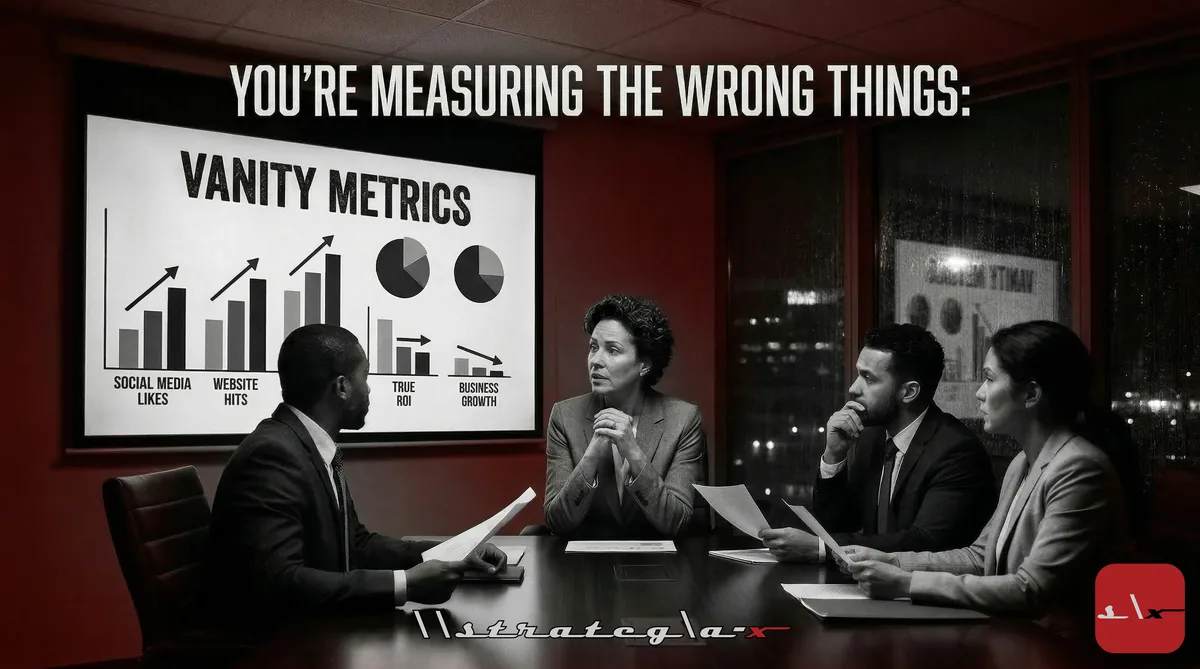
Six months later, the company missed payroll. Not because of a sudden catastrophe. Because the metrics on that dashboard, the ones everyone was celebrating, were vanity metrics. Numbers that go up and to the right, making everyone feel good, while the business slowly deteriorates underneath.
Revenue was up 18%, but profit margin had dropped from 22% to 11%. They were growing revenue by spending more than they earned on each new customer. Website traffic was up 32%, but conversion rate had dropped from 3.2% to 1.8%. More visitors, fewer buyers. Social media followers hit 50,000, but engagement rate was 0.4%, meaning 99.6% of those followers never interacted with the content. Newsletter subscribers were growing, but open rate had dropped below 12%.
Every number the leadership team tracked was going up. Every number that actually mattered was going down. And nobody noticed because nobody was looking at the right numbers.
Vanity Metrics vs. Actionable Metrics: The Critical Distinction
A vanity metric makes you feel good but doesn't inform action. An actionable metric tells you something you can act on and predicts future business health. The distinction is the difference between flying with a compass and flying with a postcard of where you used to be. Here's how the most common vanity metrics map to the actionable metrics they're hiding:
Revenue vs. Profit Margin
Revenue growth is the single most misleading metric in business. A company can grow revenue indefinitely while becoming less profitable with every sale. If your customer acquisition cost is $200 and your average customer generates $180 in lifetime value, you lose $20 every time you grow. Revenue goes up. The company dies. Track profit margin by customer segment, by product line, and by channel. Not just top-line revenue. The CEO who watches revenue without watching margin is celebrating the speedometer while ignoring the fuel gauge.
Website Traffic vs. Conversion Rate
Traffic is easy to buy. Run ads. Post content. Get featured on a list. Traffic goes up. But if visitors aren't converting to leads or customers, traffic is just electricity cost. A website with 10,000 monthly visitors and a 5% conversion rate generates 500 leads. A website with 50,000 visitors and a 1% conversion rate generates the same 500 leads, at 5x the content cost and infrastructure expense. Track conversion rates at every stage of the funnel. Visitor to lead. Lead to qualified lead. Qualified lead to customer. The conversion rates tell you whether your funnel is healthy. Traffic alone tells you nothing.
MQLs vs. SQLs
Marketing Qualified Leads (MQLs) are the vanity metric that has distorted marketing and sales alignment for a decade. Marketing generates MQLs based on form fills, content downloads, and email clicks. They hit their MQL target and declare success. Sales receives these MQLs, finds that 85% of them have no intent, no budget, and no authority, and throws them away. The pipeline is "full" on paper and empty in reality. Track Sales Qualified Leads (SQLs) and pipeline contribution. Not how many leads marketing generated, but how many leads sales accepted as real opportunities. If marketing hits their MQL target but sales isn't converting, the MQLs aren't leads, they're noise.
Customer Count vs. Customer Lifetime Value
Growing your customer base is meaningless if customers aren't staying. A company with 1,000 customers and a 40% annual churn rate is replacing 400 customers per year just to stay flat. All that acquisition spend is going to maintenance, not growth. Meanwhile, a competitor with 600 customers and 10% churn is building cumulative value with every new customer. Track Customer Lifetime Value (CLV) and churn rate together. A growing customer count with a growing churn rate isn't growth, it's a leaking bucket. And eventually, you can't pour fast enough to keep it full.
Employee Headcount vs. Revenue Per Employee
"We've grown from 30 to 75 employees!" Great. Did revenue grow proportionally? If you doubled headcount but revenue only grew 40%, your revenue per employee dropped by 30%. You're becoming less efficient as you scale. You're adding overhead faster than you're adding value. Track revenue per employee as a primary efficiency metric. The best-run SMBs maintain or improve revenue per employee as they grow. The ones that let it decline are building an organizational structure that will become unsustainable under any market pressure.
The Dashboard Delusion
The problem isn't just individual vanity metrics. It's the dashboard itself. Most executive dashboards are designed to make leadership feel good, not to surface hard truths. The marketing team designs their dashboard to highlight wins. The sales team shows pipeline value, not pipeline quality. Finance shows revenue growth, not margin erosion. Each department optimizes their dashboard for the metrics that make them look successful, regardless of whether those metrics predict business health.
The result is a leadership team that's data-rich and insight-poor. They have dashboards. They have charts. They have reports. And they still can't see the business accurately because every data source is filtered through departmental self-interest. The CEO looking at five departmental dashboards sees five successful departments and somehow a struggling company. The dashboards aren't wrong. They're just showing the metrics each department chose to show.
Leading vs. Lagging: The Indicator Framework
The most important distinction in metrics isn't vanity vs. actionable. It's leading vs. lagging.
Lagging indicators tell you what already happened. Revenue. Profit. Customer count. Employee retention rate. They're useful for reporting but useless for prevention. By the time a lagging indicator turns red, the damage is done.
Leading indicators predict what's about to happen. Pipeline velocity. Customer engagement scores. Employee satisfaction trends. Feature adoption rates. Net Promoter Score movement. Sales activity levels. They're harder to measure and less satisfying to report, but they're the only metrics that let you act before the problem becomes a crisis.
The CEO who watches leading indicators catches the churn problem when customer engagement starts declining, three months before the churn shows up in the retention numbers. The CEO who watches lagging indicators catches the churn problem when revenue drops, three months after the customers already left and took their business to a competitor.
The 5 Metrics Every SMB CEO Should Check Daily
If you want a single dashboard that actually tells you whether your business is healthy, track these five metrics, updated daily where possible:
- 1. Cash runway: How many months can you operate at current burn rate without additional revenue? This is the only metric that kills companies directly. Everything else is survivable. Running out of cash is not.
- 2. Gross margin by product/service: Not blended. By line. You need to know which products make money and which products consume money. Blended margins hide the products that are dragging the business down.
- 3. Sales pipeline velocity: Not pipeline value, pipeline velocity. How fast are deals moving through your funnel? Stalling pipeline is the leading indicator that revenue is about to decline, even if the pipeline value looks healthy.
- 4. Customer churn rate (trailing 90 days): Not annual. Trailing 90 days gives you a real-time view of retention health. If this number is climbing, everything else is irrelevant until you fix it.
- 5. Revenue per employee: The efficiency check. If this is declining, you're scaling your cost structure faster than your revenue. The fix isn't always headcount reduction, it might be process efficiency, automation, or pricing adjustment.
The Bottom Line
Your dashboard is probably lying to you. Not maliciously, structurally. It's showing you the numbers that feel good instead of the numbers that matter. Revenue without margin. Traffic without conversion. Leads without quality. Growth without efficiency.
The companies that survive aren't the ones with the best-looking dashboards. They're the ones tracking the metrics that predict the future, not the ones that celebrate the past. Strip the vanity off your metrics. Kill the dashboards designed to make departments look good. Build one dashboard that tells the truth, even when the truth is uncomfortable. Because the CEO who sees the real numbers today can fix the problems tomorrow. The CEO who only sees vanity metrics won't see the problems at all, until it's too late to fix them.
-Rocky
#Businessmetrics #Kpis #Businessoperations #Analytics #Leadership #Datadriven #Smb #Strategy #EngineeringDreams #StrategiaX