The Software Paradox Nobody Wants to Acknowledge
The supply chain management software market is booming. Oracle, SAP, Kinaxis, Blue Yonder, Coupa, vendors are shipping AI-powered demand forecasting, real-time visibility platforms, digital twins, and predictive analytics. Analyst firms project the market will exceed $19.3 billion by 2026, growing at nearly 12% annually.
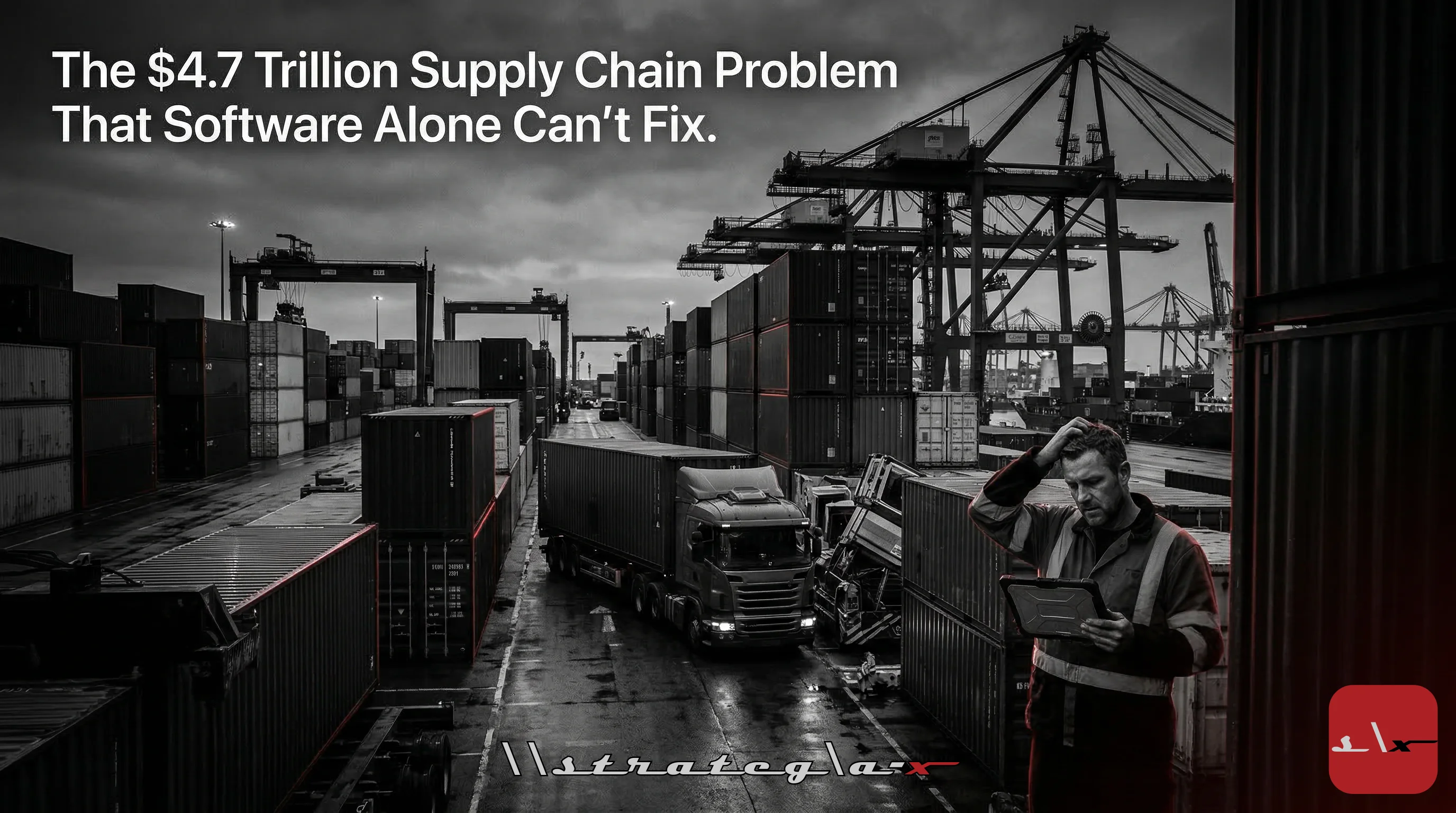
Meanwhile, supply chain disruptions are getting worse. McKinsey estimates that supply chain disruptions cost the global economy $4.7 trillion between 2020 and 2023. The World Economic Forum reports that 73% of supply chain leaders experienced significant disruptions in 2024 alone. Inventory levels remain volatile. Lead times are unpredictable. And every company with a supply chain is still playing whack-a-mole with shortages, delays, and cost spikes.
How is this possible? How does an industry spending nearly $20 billion on management software keep producing worse outcomes? The answer is uncomfortable but simple: the software works fine. The organizations using it don't.
The 75% Failure Rate Nobody Talks About
ERP implementations, the foundational layer of supply chain management, fail at staggering rates. Gartner estimates that 75% of ERP projects fail to meet their objectives. Not 25%. Not half. Three out of four. And the failures aren't because the software is bad. The failures happen because companies buy software expecting it to impose order on organizational chaos. It can't.
A typical pattern: a company with broken procurement processes buys a supply chain planning tool. They implement it on top of the broken processes. The software faithfully automates the broken processes, making them faster, not better. They're now making bad decisions at machine speed instead of human speed. The forecasting module produces garbage forecasts because it's built on garbage data. The procurement module generates purchase orders based on reorder points that nobody validated. The analytics dashboard visualizes noise and calls it insight.
The company concludes the software doesn't work. They look for a different vendor. They buy another tool. The cycle repeats. They keep solving a process problem with a technology purchase. And they keep getting the same result.
The Data Quality Crisis Underneath Everything
Every supply chain software platform is built on a simple premise: good data in, good decisions out. The premise is correct. The assumption that companies have good data is not.
A study by Gartner found that the average organization believes its data quality is 97% accurate. Independent audits consistently show actual accuracy closer to 75-80%. That 20% error rate cascades through every calculation, every forecast, and every automated decision the supply chain software makes.
Where does bad supply chain data come from?
- Master data inconsistency: The same part has three different SKUs in three different systems. The same supplier is entered as "ABC Corp," "ABC Corporation," and "A.B.C. Corp" in the vendor master. There's no single source of truth, so every report produces slightly different numbers.
- Stale inventory counts: The system says you have 500 units. The warehouse has 420. The discrepancy is 80 units, representing weeks of unrecorded shrinkage, damage, miscounts, and undocumented returns. Your demand planning tool is forecasting against inventory that doesn't exist.
- Undefined lead times: The supplier's quoted lead time is 6 weeks. The actual average lead time over the past 12 months is 9.3 weeks with a standard deviation of 2.8 weeks. But nobody's tracking actuals, just quoting the vendor's published number. Every safety stock calculation built on that fictional lead time is wrong.
- Missing demand signals: The forecast is built on historical shipment data. But shipment data doesn't capture lost sales, the orders that customers wanted to place but didn't because you were out of stock. You're planning based on constrained demand, not actual demand. Your forecast systematically underestimates true demand because it only sees what you were able to fulfill.
No software can overcome this. Garbage in, garbage out is not a cliché, it's a law. And it's operating in every supply chain that hasn't invested in data governance before investing in software.
The Human Layer Technology Can't Replace
Supply chains are built on relationships. The supplier who expedites your order because your procurement manager has built trust over seven years. The logistics broker who finds capacity during peak season because they know your freight history and your flexibility. The contract manufacturer who prioritizes your production run because you're their most communicative and predictable customer.
Software can track these relationships. It can store contact information, log communications, and measure performance. What it can't do is build the relationship. It can't call the supplier at 6 AM when a container is stuck at port and negotiate a priority release. It can't sense that a vendor's quality is declining before the data shows it, but a procurement manager who visits the factory floor quarterly can. It can't build the goodwill that turns a transactional vendor into a strategic partner.
Companies that over-invest in vendor management software while under-investing in vendor relationship management end up with perfectly documented transactional relationships that collapse under pressure. The software tells you the supplier's on-time delivery rate. The relationship determines whether they call you first when allocation gets tight, or last.
Process Before Platform: The Framework That Works
Here's the uncomfortable truth: you have to fix the process before you buy the software. Not simultaneously. Before. Here's the framework for technology-enabled, not technology-driven, supply chain transformation:
Phase 1: Process Mapping and Standardization
Before evaluating any software, map your actual supply chain processes end-to-end. Not the theoretical process in the SOP manual. The actual process, the one with the workarounds, the manual email approvals, the spreadsheet that Frank in procurement maintains on his desktop. Document every step, every handoff, every decision point. Identify which steps add value and which are waste. Standardize the process across locations, teams, and product lines. If the process is different in every warehouse, no software implementation will create consistency, it will just automate inconsistency.
Phase 2: Data Foundation
Audit your master data. Deduplicate vendor records. Validate inventory counts with physical cycle counts, not annual audits, but rolling counts that maintain accuracy continuously. Establish a single source of truth for part numbers, supplier information, lead times, and costs. Implement data governance, clear ownership of data quality, defined standards for data entry, and automated validation rules that prevent garbage from entering the system. This phase is boring, tedious, and absolutely critical. Skip it and everything built on top of it will fail.
Phase 3: Technology Selection and Implementation
Now, with clean processes and clean data, select software that fits your actual needs. Not the most feature-rich platform. Not the vendor your peers use. The platform that supports the standardized processes you've already defined, integrates with the systems you already have, and can be operated by the team you actually employ. Implement in phases. Start with the highest-value, lowest-risk module. Prove it works. Build confidence. Expand from there. The companies that implement everything at once fail at everything. The ones that implement sequentially succeed cumulatively.
Phase 4: Continuous Improvement and Relationship Investment
Technology is not a project. It's a practice. After go-live, invest in continuous process refinement, ongoing data quality monitoring, and, critically, the human relationships that no dashboard can replace. Schedule quarterly supplier reviews. Send your procurement team to visit critical suppliers. Build the personal connections that create resilience when the next disruption hits. Allocate at least 20% of your supply chain technology budget to training, change management, and relationship building. The software is the tool. The people are the strategy.
What the Vendors Won't Tell You
The software vendors have a financial incentive to sell you the platform before you're ready for it. Their sales cycle doesn't include a "fix your data quality first" phase. Their implementation timeline doesn't account for the six months of process standardization you should do before the first module goes live. Their ROI projections assume clean data, standardized processes, and enthusiastic user adoption, none of which exist until you create them.
This isn't malice. It's incentive alignment. The vendor's job is to sell software. Your job is to create the organizational conditions under which that software can deliver value. Those are different jobs, and only one of them is your responsibility.
The Bottom Line
The $4.7 trillion supply chain problem isn't a software problem. It's a process, data, and people problem that software alone cannot solve. The platforms are powerful. The analytics are sophisticated. The AI is impressive. None of it matters if the processes are broken, the data is dirty, and the relationships are transactional.
Fix the process before you automate it. Clean the data before you analyze it. Invest in relationships before you digitize them. Then, and only then, will the $19.3 billion supply chain software market deliver the value it promises. The companies that get this sequence right will build supply chains that bend without breaking. The ones that keep buying software to solve organizational problems will keep spending money to automate their own dysfunction.
-Rocky
#Supplychain #Erp #Digitaltransformation #Industryinsights #Processimprovement #Dataquality #Smb #EngineeringDreams #StrategiaX