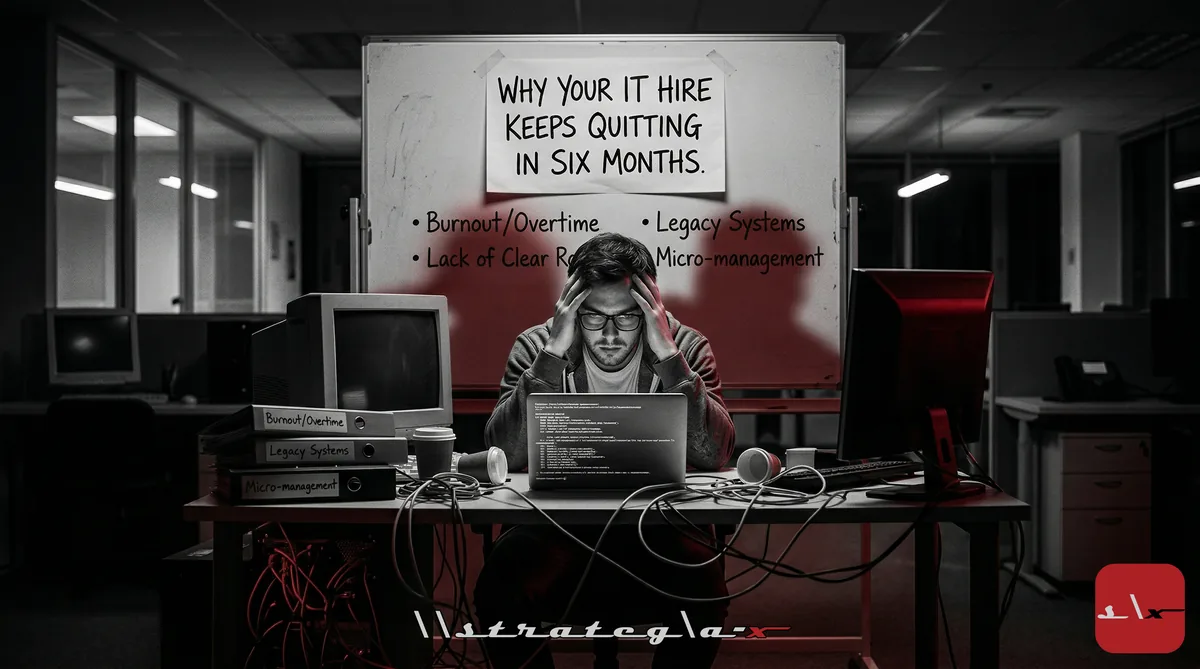
You Don't Have an IT Hiring Problem. You Have an IT Expectations Problem.
The pattern is always the same. An SMB decides it's time to bring IT in-house. They write a job description that's really four different job descriptions stapled together. They hire someone who seems competent and enthusiastic. For the first few months, things improve, the new hire puts out the biggest fires, fixes the most visible problems, and makes the chaos slightly more manageable.
Then, around month four or five, the emails start arriving. Can you set up the new employee's laptop? The printer on the third floor isn't working. We need a cybersecurity audit by Friday. The CEO wants to migrate to a new CRM by next quarter. The Wi-Fi in the conference room is spotty. Also, we need you to evaluate our cloud spend and present a cost optimization plan to the board.
By month six, your IT hire is exhausted, overwhelmed, and updating their LinkedIn profile. By month eight, they're gone. And the cycle repeats.
I've seen this pattern at dozens of SMBs. It's not a talent problem. It's a structural problem. And until you fix the structure, no hire will survive it.
The Impossible Job Description
Pull up the average "IT Manager" job listing at an SMB. Here's what you'll typically find, one person expected to handle:
- Help desk support: Password resets, laptop issues, printer problems, software installations, "my email isn't working"
- System administration: Server management, network configuration, backup monitoring, patching, updates
- Cybersecurity: Firewall management, endpoint protection, vulnerability scanning, incident response, compliance
- Vendor management: ISP relationships, SaaS vendor negotiations, hardware procurement, contract renewals
- Project management: System migrations, new tool deployments, infrastructure upgrades, office relocations
- Strategy: Technology roadmap, budget planning, board presentations, digital transformation initiatives
In a large enterprise, these responsibilities are distributed across 6-10 different roles with corresponding teams. At an SMB, they're compressed into a single position with a salary that reflects maybe two of those roles.
The person you hired isn't failing. The job is impossible.
Why Good IT People Leave SMBs
1. Reactive Firefighting, Never Strategic Work
The number one reason IT professionals leave SMBs is that they spend 100% of their time on break-fix work and 0% on the strategic projects they were hired to do. They were promised they'd modernize the infrastructure, implement better security, and drive digital transformation. Instead, they're fixing printers, resetting passwords, and troubleshooting VPN issues.
Strategic work is what IT professionals find fulfilling. It's what advances their career. And at an understaffed SMB, it never gets done because the urgent always displaces the important.
2. No Budget for Real Solutions
You hired an IT professional to solve problems. But solving problems requires investment, in tools, in infrastructure, in training, in external expertise. When every budget request is met with "we just hired you, why do we need to spend more?" the IT hire realizes they've been set up to fail. They were hired to fix things, but they weren't given the resources to fix anything.
A skilled IT professional without budget is a mechanic without tools. They can diagnose the problem. They can tell you exactly what needs to happen. But they can't execute without investment, and when that investment is perpetually denied, they leave for somewhere that will actually fund their work.
3. Unrealistic Scope With Zero Support
Being the sole IT person at a 50-200 employee company means being on call for everything, always, with no backup. Every system outage is your problem. Every security incident is your responsibility. Every user who can't figure out their software is your interruption. There's no team to share the load. There's no tier-1 support to handle the routine stuff. There's no senior colleague to consult on complex decisions.
The burnout rate for solo IT positions at SMBs is staggering. It's not the technical difficulty, it's the relentless, unstructured, all-encompassing nature of the role combined with the isolation of being the only person who understands the infrastructure.
4. No Career Path
In a larger organization, an IT professional has a clear growth trajectory: junior admin → senior admin → team lead → manager → director → VP/CTO. At an SMB with a single IT position, the career path is: IT person → still IT person → still the same IT person, forever. There's no promotion, no team to grow into, no expanding scope of leadership. And talented people want to grow.
How to Actually Fix This
If you recognize this pattern, here's how to break the cycle:
1. Right-Size the Role
Be honest about what one person can actually accomplish. A single IT hire can realistically handle either day-to-day operations or strategic projects, not both. Decide what you need most. If it's operational support, hire for that and outsource strategy to a consultant. If it's strategic transformation, outsource day-to-day operations to an MSP and hire someone focused on planning and execution.
2. Supplement With an MSP or Co-Managed IT
The most successful SMB IT model I've seen isn't fully in-house or fully outsourced. It's co-managed: an internal IT person who owns strategy, vendor relationships, and escalated issues, supported by a managed service provider (MSP) that handles help desk, monitoring, patching, and routine maintenance.
This gives your internal hire the bandwidth to focus on strategic work while ensuring day-to-day operations don't fall on a single person's shoulders. It also provides backup coverage for vacations, sick days, and high-volume periods.
3. Fund the Position Properly
The IT budget isn't just the salary. It's the tools, licenses, infrastructure, training, and external expertise that your IT hire needs to actually do their job. A general rule: for every dollar you spend on IT headcount, budget an additional 50-75% for tools, services, and project investment. If you're hiring an IT manager at $90K, budget $45-67K for the resources they'll need. If that feels like too much, you can't afford to bring IT in-house yet, and that's okay. An MSP might be the right model until you can fund a properly resourced internal team.
4. Define Clear Priorities
Your IT hire can't do everything. Work with them to define the top 3-5 priorities for each quarter. Anything outside those priorities either waits, gets outsourced, or requires a scope discussion. This isn't about limiting what they do, it's about ensuring that the most important work actually gets done instead of being crowded out by an infinite queue of reactive requests.
5. Create Growth Opportunities
Even without a traditional promotion ladder, you can provide growth: conference attendance, certification funding, expanded responsibilities as the company grows, a voice in strategic decisions, and a clear commitment that the IT function will scale with the business. Talented people stay where they're growing. Show them a future.
The Bottom Line
Your IT hire isn't quitting because they can't handle the work. They're quitting because the work as defined is structurally impossible for one person. You wouldn't hire one person to be your company's entire sales department, entire marketing team, and entire customer success function simultaneously. But that's exactly what most SMBs do with IT, and then wonder why the revolving door keeps spinning.
Right-size the role. Fund it properly. Supplement with external support. And treat your IT function like what it actually is: the foundation that every other department depends on. Get the structure right, and you'll finally keep the talent you keep hiring.
-Rocky
#Ithiring #Smb #Talentretention #Managedservices #Itstrategy #Techleadership #Burnout #Itops #Comanagedit #Staffing #EngineeringDreams #StrategiaX